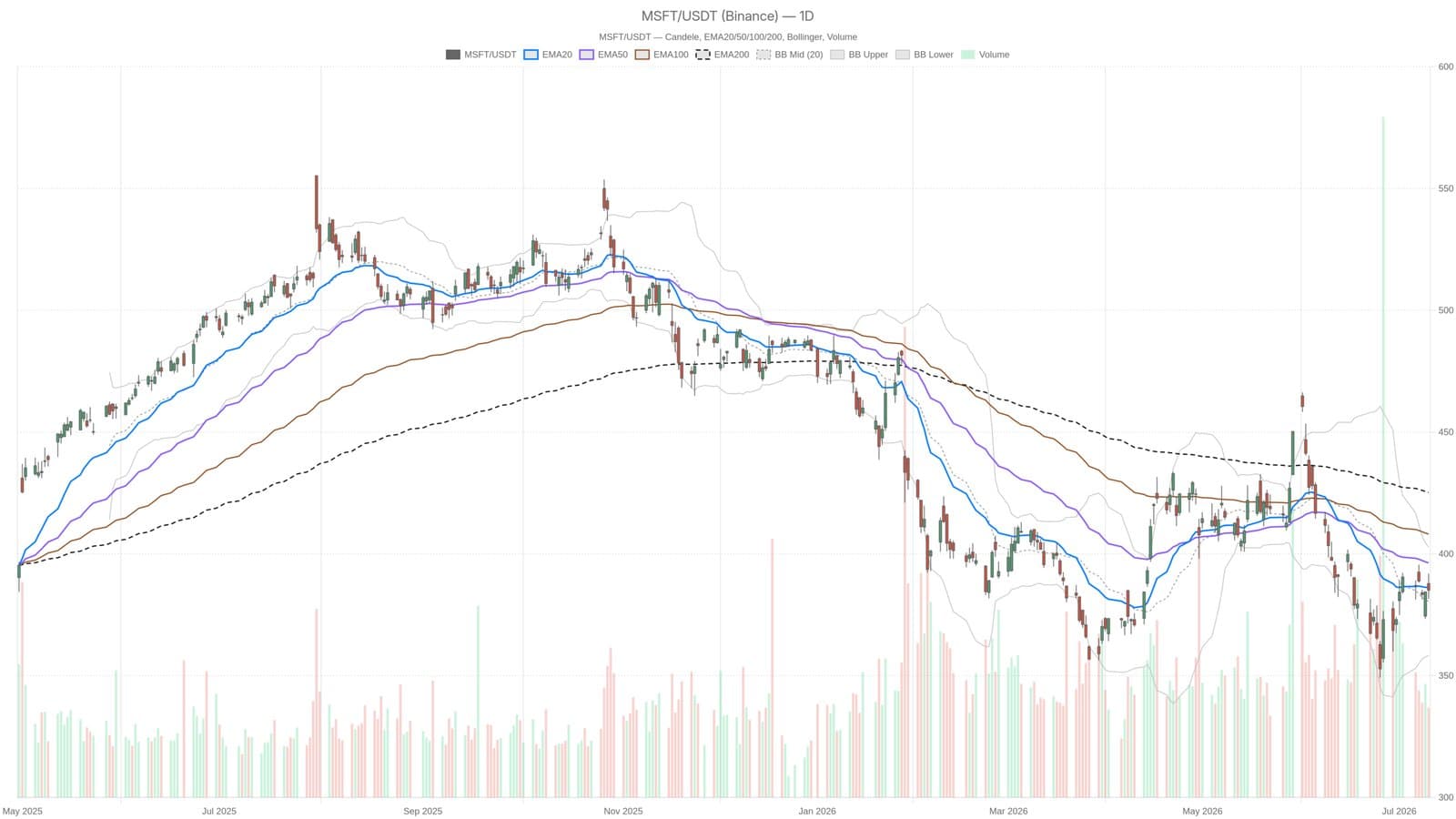
As of July 10, Microsoft stock (MSFT) closed at $385.10, reflecting a significant decline of approximately 18% year-to-date. This downturn is particularly noteworthy considering the stock's performance has been primarily bearish, although recent intraday price movements suggest a potential stabilization. Despite this, the prevailing sentiment in the market remains cautious, leaning towards a bearish outlook.
The technical indicators paint a clear picture of the current bearish regime. Microsoft is trading below both its 20-day and 50-day exponential moving averages (EMA), which are positioned at $386.18 and $396.29, respectively. Additionally, the 200-day EMA, sitting at $425.25, indicates a considerable gap between the stock's current price and its long-term trend. Such discrepancies typically reinforce negative sentiment among investors, as they highlight the absence of strong recovery signals.
Further analysis shows that the daily Relative Strength Index (RSI) is at 47.52, which is below the neutral midpoint of 50. This lack of upward momentum suggests that the stock is neither oversold nor poised for a significant rebound. However, the recent shift in the Moving Average Convergence Divergence (MACD) histogram, which turned positive at +2.48, indicates that while bearish momentum is still present, it is beginning to decelerate. This subtle change could be interpreted as a glimmer of hope for bulls, even if it falls short of signaling a complete reversal.
The volatility surrounding Microsoft stock remains pronounced, as evidenced by the Average True Range (ATR) of $12.68. This metric suggests that investors should brace for wider price swings, which could lead to unpredictable trading sessions. The Bollinger Bands further illustrate this volatility, with the stock trapped between a midline at $380.51 and an upper band at $402.80, accompanied by potential support at the lower band around $358.22. In this context, the daily pivot levels, with a pivot point at $386.17 and resistance at $390.84, underscore the critical thresholds that traders will need to monitor.
On an hourly timeframe, there are signs of stabilization emerging, as short-term EMAs are flipping below the price. This could imply that the stock is finding some footing, although it remains to be seen whether this stabilization can translate into a sustained recovery. The market's perception of Microsoft's long-term growth potential continues to be clouded by broader macroeconomic factors and competition within the tech sector. Investors will need to remain vigilant as they assess whether the current price action is merely a temporary respite in a longer-term downtrend or the beginning of a more favorable trajectory for the stock.
This material is for informational purposes only and should not be considered financial advice.