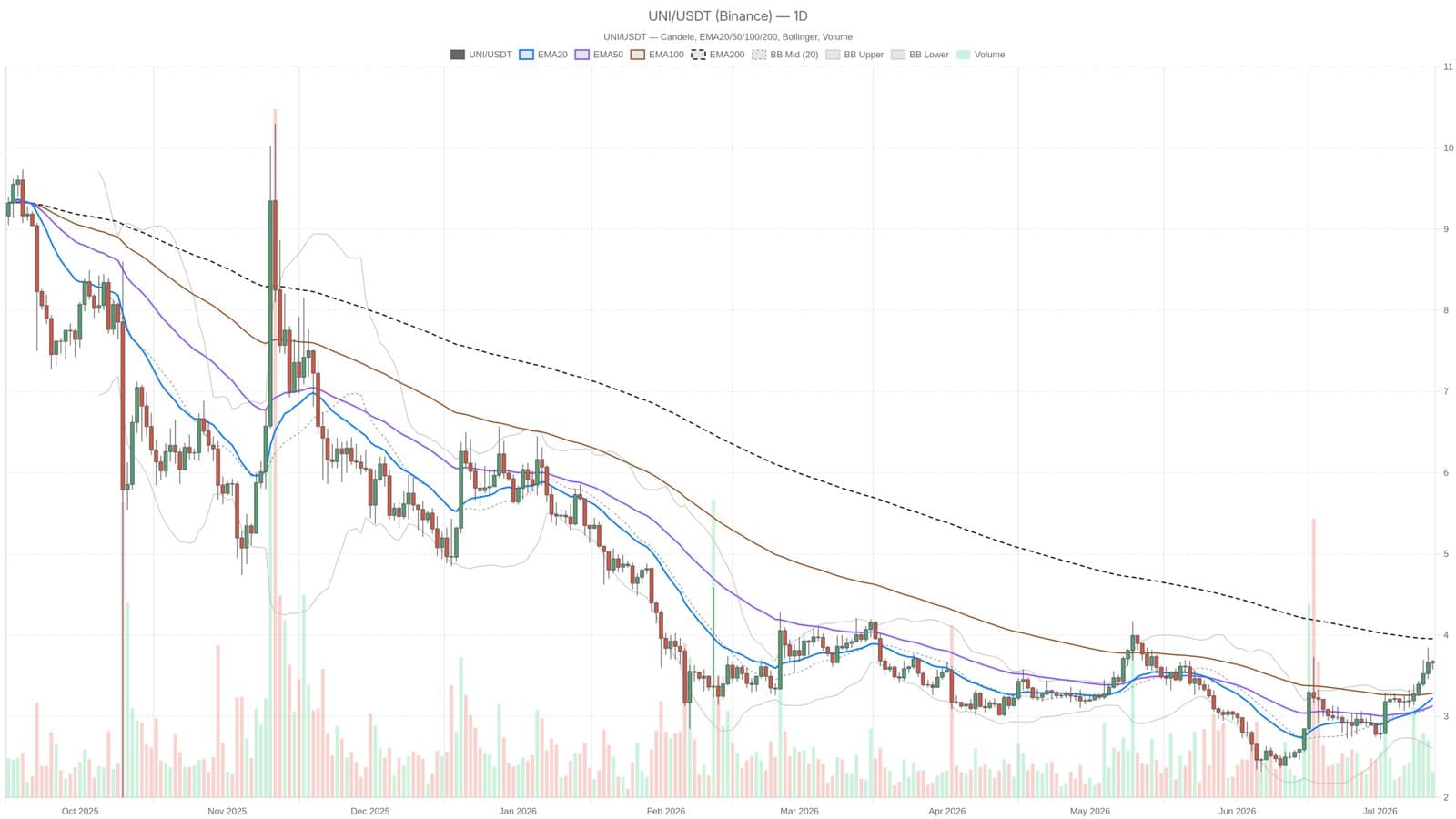
As of July 12, 2026, Uniswap's UNI token trades at $3.68, a seemingly benign price point. However, a deeper look reveals that the token is perched precariously at the upper Bollinger Band on the daily chart, which typically signals a potential reversal. The daily Relative Strength Index (RSI) is at 75.55, an indicator often associated with overbought conditions and subsequent price corrections.
The broader market dynamics further complicate the outlook for UNI. The Fear & Greed Index is at a low 26, indicating a risk-off sentiment among investors, while Bitcoin's dominance is at 56.24%. This backdrop suggests that alternative coins like UNI are struggling for traction amid a market that is favoring Bitcoin, raising concerns about potential downward pressure on its price.
Market Indicators and Uniswap’s Fee Surge
On the decentralized exchange (DEX) front, Uniswap V3 has experienced a remarkable surge in trading fees, boasting an increase of over 330% in the last 30 days. This spike provides a fundamental support layer for UNI's current price level, suggesting that the heightened trading activity is a driving force behind its recent performance.
Despite this positive development, the technical indicators paint a cautious picture. The price is currently above significant moving averages, with the EMA20 at $3.23 and EMA50 at $3.13, illustrating a bullish short-term trend. However, the EMA200 at $3.95 looms above, acting as a long-term resistance that could limit further gains. A break above $3.72 could signal a continuation of the upward momentum, while a drop below $3.60 would likely indicate a bearish shift.
Conclusion: A Delicate Balance
Overall, while Uniswap's fee increase is a promising sign of activity within the platform, the overbought conditions, coupled with the overall bearish market sentiment, create a precarious situation for UNI investors. The upcoming price movements will be critical to watch, as they will likely dictate the broader sentiment surrounding the token and potentially influence trading strategies moving forward.
This material is informational and should not be considered financial advice.