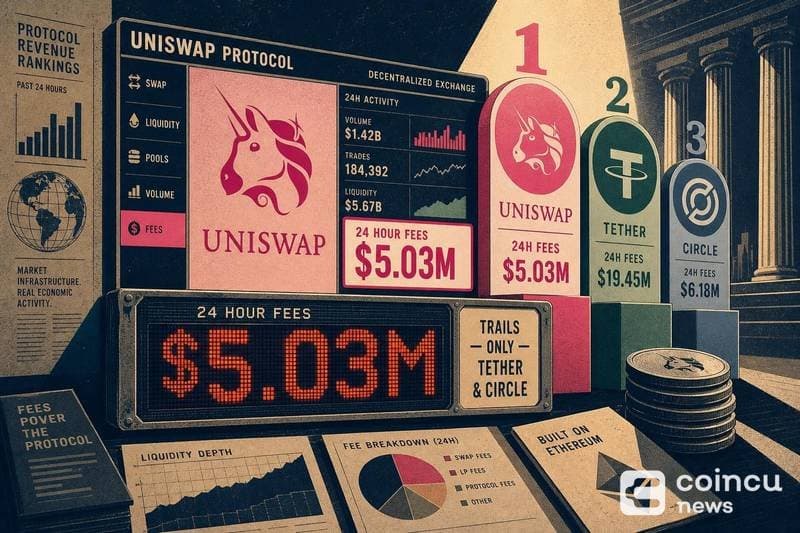
Uniswap has recently reported an impressive $5.03 million in transaction fees generated over a 24-hour period, positioning itself just behind Tether and Circle in the race for fee generation within the cryptocurrency sector. This metric not only underscores Uniswap's role as a leading decentralized exchange (DEX) but also highlights significant trading demand in the DeFi landscape.
The Significance of Uniswap's Fee Generation
The fee generation figures indicate heightened activity on Uniswap, reflecting a snapshot of trader participation during a specific timeframe. This level of revenue suggests that Uniswap is experiencing a concentrated volume of trading activity, which is quite noteworthy given that it operates on a decentralized model, unlike Tether and Circle, which are centralized entities generating fees from stablecoin transactions across various blockchains.
Uniswap's ranking in fee generation is particularly significant as it indicates a growing preference for decentralized trading venues, which can be attributed to factors such as increased market volatility and speculative trading. As traders seek out platforms that offer greater autonomy and less reliance on centralized systems, Uniswap's performance serves as a real-time barometer of engagement in the DeFi ecosystem.
Implications for Future Protocol Development
This impressive fee figure comes at a time when Uniswap Labs is contemplating the introduction of protocol fees for its version 4 pools. Such a move could enable the protocol to redirect a portion of these earnings back to its development and operational costs, rather than solely benefiting liquidity providers. This evolution may enhance the sustainability and profitability of the DEX model as a whole.
As decentralized exchanges continue to mature, they are likely to see fluctuations in fee generation based on broader market conditions, including the launch of new tokens and shifts in investor sentiment. Uniswap's recent performance may signal a pivotal moment for the DEX sector, where peer-to-peer transaction models could increasingly challenge traditional centralized exchanges.
This material is informational and should not be considered financial advice.