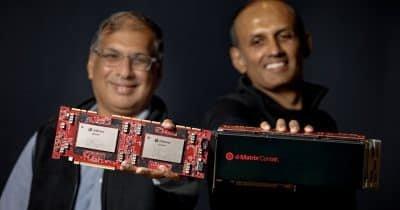
D-Matrix has made headlines with the launch of its Corsair AI inference platform, a product that promises to reshape the competitive landscape dominated by Nvidia. With reported speeds up to ten times faster than Nvidia GPUs and a valuation reaching $2 billion after a successful Series C funding round of $275 million, this startup is not merely another player; it presents a direct challenge to established norms in AI hardware.
Understanding D-Matrix's Challenge to Nvidia
The Corsair platform is not just an incremental upgrade; it employs a unique architecture known as 3DIMC (digital in-memory compute), addressing a significant bottleneck in traditional GPU designs. While conventional GPUs struggle with data logistics, forcing data to travel between memory and processing units, the 3DIMC architecture keeps data 'in the kitchen', fundamentally enhancing processing speeds and efficiency.
- 10x faster AI inference compared to Nvidia
- 5x better energy efficiency on generative AI workloads
- Processes 30,000 tokens per second for AI models like Meta’s Llama 70B
This technology claims to address the critical cost components of AI deployment namely, inference, which is the ongoing operational expense rather than the resource-heavy training phase. As the demand for AI continues to proliferate, understanding how inference costs impact overall ownership becomes crucial for stakeholders across sectors.
Market Dynamics and Investor Implications
The implications for investors in AI-related cryptocurrencies and tokens are multifaceted. The launch of advanced inference hardware like Corsair introduces both potential risks and opportunities in the ecosystem. Companies that have anchored their business models on the presumption of GPU scarcity may find their assumptions tested. However, projects adept at leveraging various architectures within AI deployments are likely to derive greater benefits from hardware advancements.
Moreover, decentralized compute networks such as Akash and Render may start to incorporate these specialized inference chips into their frameworks. Such a transition would validate the diversification of hardware as a viable strategy and prompt a reconsideration of existing market models.
Future Outlook: Key Developments to Monitor
As we look ahead, several key developments warrant close attention:
- Further innovations in the Corsair platform and its adoption rate in industry applications
- Responses from established networks to the emergence of non-GPU accelerators
- Market reaction as the competitive landscape shifts and more entities enter the specialized hardware arena
By closely observing these trends, investors and stakeholders can better navigate the evolving dynamics shaped by D-Matrix's innovations in AI hardware.
This article is for informational purposes and should not be considered financial advice.