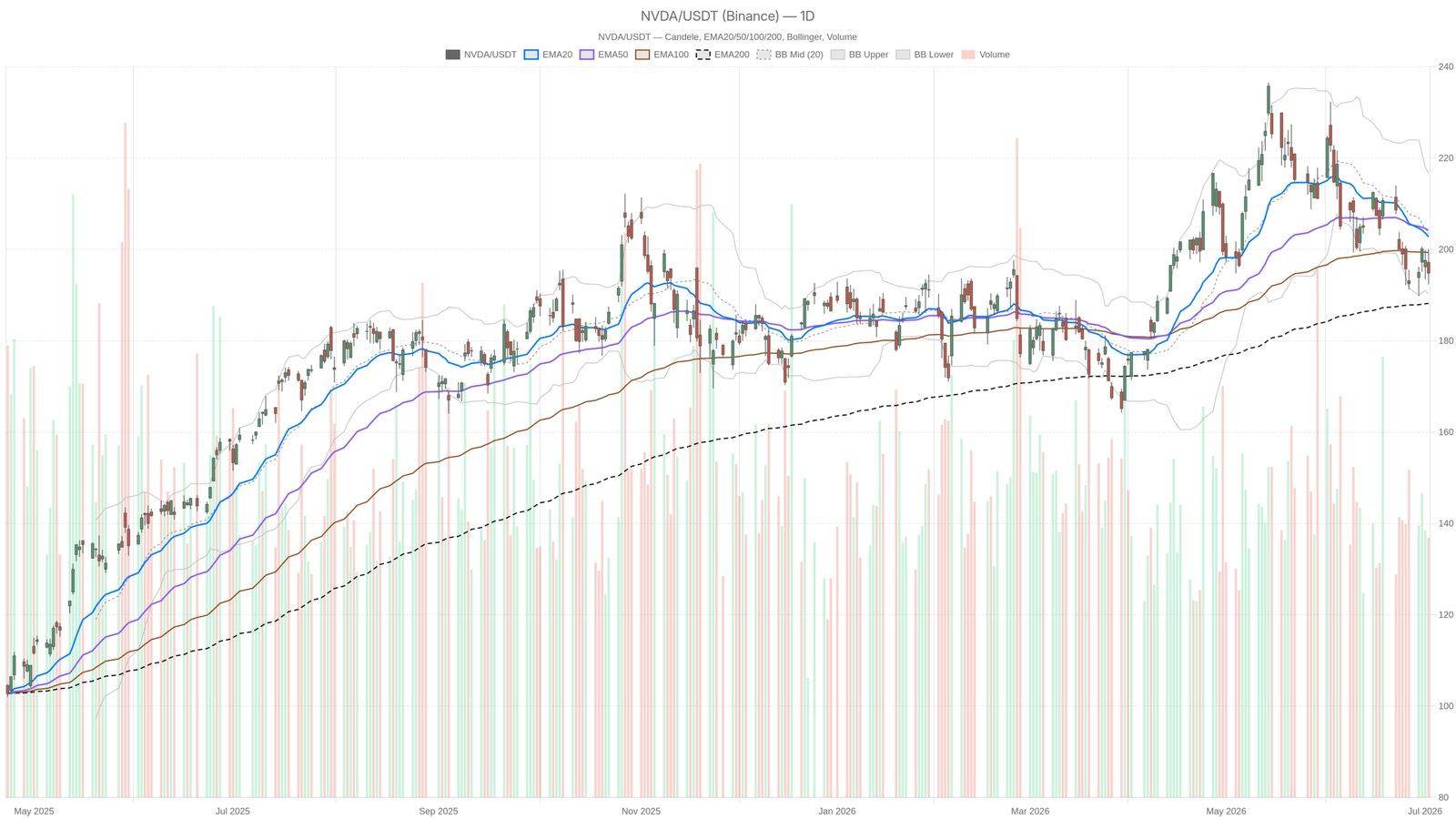
Nvidia's recent stock performance poses critical questions for market analysts and investors alike. As of July 6, 2026, Nvidia's shares sit at approximately $194.83, reflecting a 13% decline in the past month, indicating a significant bearish trend. This scenario warrants a closer examination of potential recovery narratives amidst a turbulent market phase.
Technical Analysis Highlights
Currently, Nvidia trades below its short-term exponential moving averages (EMA20 at $202.75 and EMA50 at $204.19), signaling overhead resistance and a lack of positive momentum. The daily relative strength index (RSI) at 41.16 suggests that the stock is edging towards oversold conditions but has yet to signal a definitive reversal. Stagnation in the MACD reading, which is at -4.09, further confirms the persisting bearish sentiment.
Market Sentiment and Analyst Optimism
Nonetheless, the fundamental backdrop shows glimmers of hope for recovery. Notably, 44 upward revisions in earnings per share (EPS) juxtaposed with only four downward revisions imply a robust conviction among analysts regarding Nvidia's long-term prospects. The persistent demand for AI infrastructure underscores this bullish narrative, although the current dip reflects caution in the short term.
Implications of Resistance Levels
For the bullish case to gain traction, Nvidia needs to break above the pivotal resistance zone around $199 to $200. A strong close above these levels could signal a reversal from the current bearish momentum, potentially attracting bullish traders. Conversely, if shares dip below the support level of $191.43, the next target could be the EMA200 at $188.17, which represents a crucial structural anchor in the uptrend.
Conclusion: Navigating the Current Landscape
As Nvidia navigates these challenging waters, risk management becomes imperative for investors. The volatility indicated by the daily average true range (ATR) of $6.34 suggests possible intraday swings, compelling traders to adopt strategic positions. Understanding these dynamics is crucial, especially in a market where sentiment can shift rapidly, as seen in other sectors affected by fluctuations. Thus, the interplay between bearish technical indicators and bullish analyst sentiment will ultimately shape Nvidia's trajectory in the coming weeks.