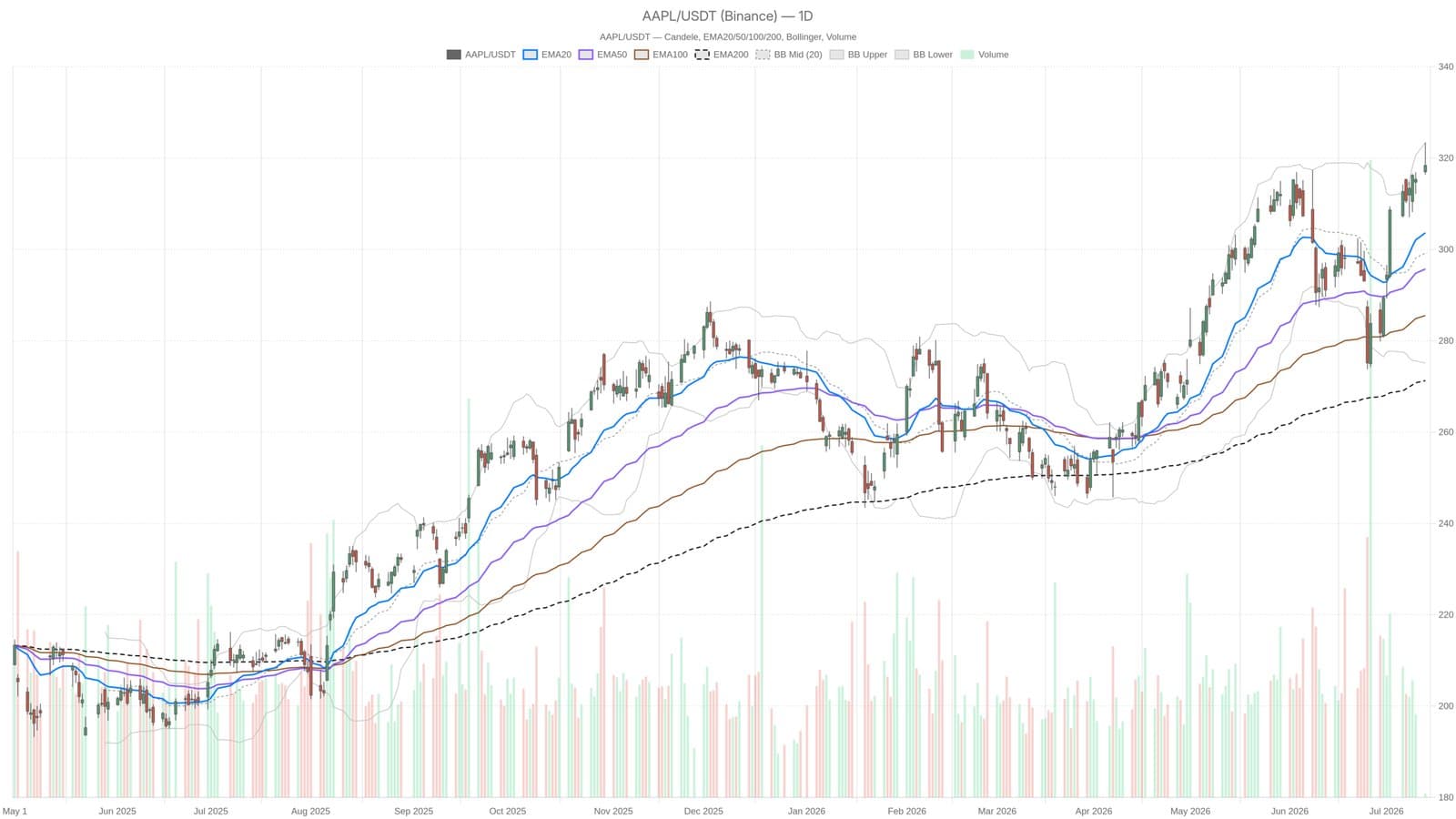
Apple Inc. (AAPL) has achieved a remarkable milestone by reaching an all-time high of $318.79 on July 13, 2026. This accomplishment not only underscores the company's enduring bullish momentum but also raises critical questions about the sustainability of this rally amidst a complex market backdrop.
Current Market Dynamics
The stock has been trading well above all major moving averages, including the EMA20 at $303.63, EMA50 at $295.71, and EMA200 at $271.27. This positioning indicates a strong bullish trend. However, recent intraday momentum shows signs of thinning, suggesting that the rally may be losing steam.
Key technical indicators provide mixed signals. The daily Relative Strength Index (RSI) stands at 64.78, indicating that while the stock is nearing overbought territory, it has yet to cross into it. Furthermore, the daily MACD remains positive, with a histogram reading of 2.74, reinforcing the notion of active upward momentum.
Risks and Consolidation Ahead
Despite the bullish signals, the Bollinger Bands indicate a potential short-term overextension. The upper band currently sits at $323.37, closely aligned with the recent intraday high of $323.42. This touch and subsequent pullback can be interpreted as a classic indicator of market overextension, implying a need for consolidation before any further upward movement. Coupled with an elevated daily Average True Range (ATR) of $9.12, traders should be vigilant regarding position sizing, as volatility remains pronounced.
Importantly, Citi has raised its price target for AAPL to $365, a bullish sentiment offset by potential margin pressures from rising NAND and DRAM costs, along with ongoing legal challenges involving OpenAI. The critical support level is now marked at $315.36; a break below this point could jeopardize the current bullish structure.
As the market grapples with these dynamics, investors must weigh the implications of AAPL's performance against the backdrop of broader economic conditions. For those interested in the intersection of technology and finance, understanding these nuances is essential for navigating this evolving landscape.
This material is informational and should not be considered financial advice.