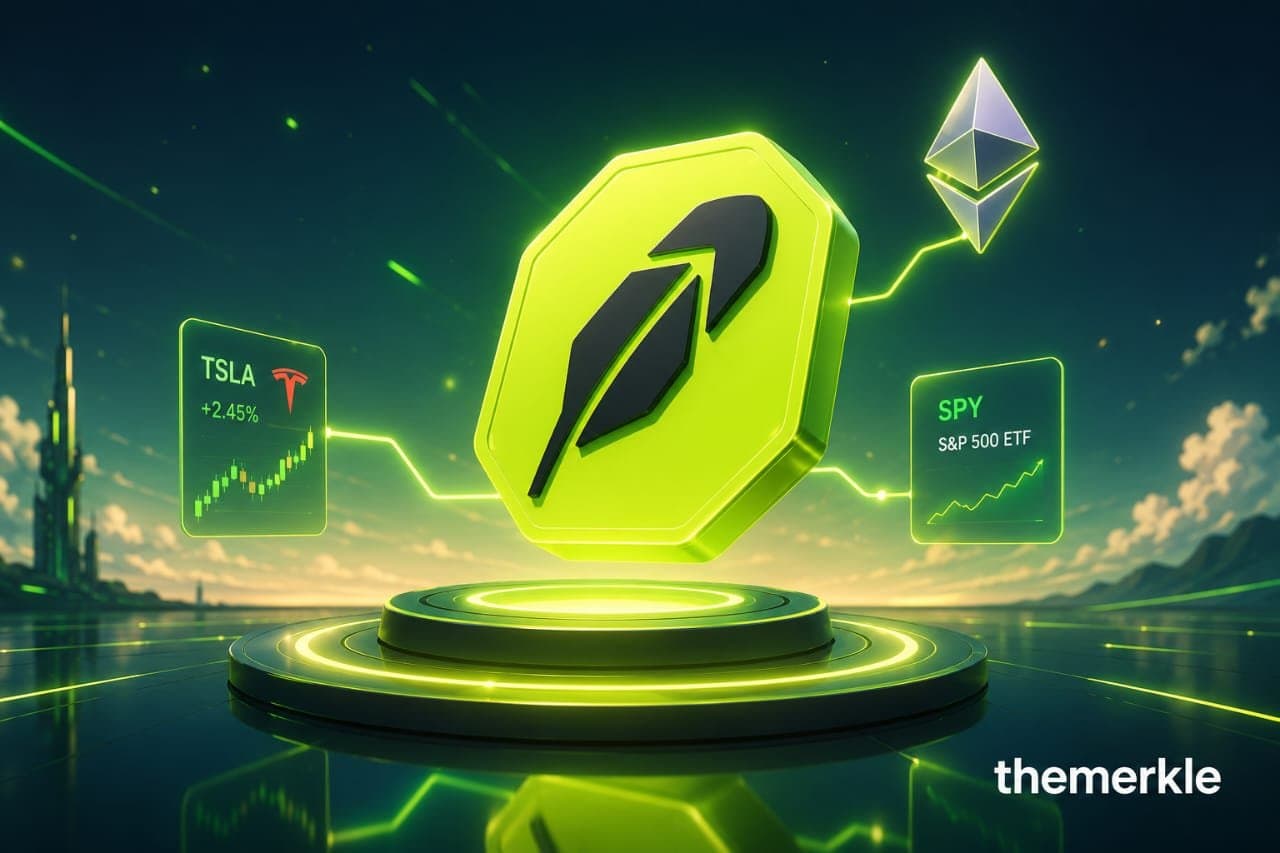
July 1 was the date. Robinhood Chain opened its public mainnet, and within three weeks the developer activity looked less like a cautious pilot and more like a land grab.
The chain is a dedicated Ethereum Layer 2 built on Arbitrum's Orbit stack, a framework that lets teams spin up customizable L2 or L3 chains without assembling consensus infrastructure from scratch. That technical choice is not incidental: it is the entire argument.
Shared infrastructure like Arbitrum One, where Robinhood actually launched its first tokenized stock products in 2025, means competing for block space with every other protocol on the network. General-purpose chains are optimized for nothing in particular, which makes them adequate for most use cases and genuinely ideal for almost none.
Robinhood Chain sidesteps that entirely. The chain is tuned specifically around tokenized real-world assets, fast execution, predictable fees, and financial applications built to handle serious transaction volume. For a developer building anything in that neighborhood, that specificity is a real advantage, not a marketing line.
Settlement still goes to Ethereum. Transactions are processed off the main network, batched, and posted back for final settlement and data availability. That architecture is what lets the chain offer lower fees and faster execution while inheriting Ethereum's security model rather than building trust from zero. Developers working on Ethereum-adjacent infrastructure will recognize immediately why that matters: you get the speed of an L2 with the finality guarantees of the base layer.
The asset angle is where things get genuinely unusual. Robinhood's tokenized stocks and ETFs are not just tradable on the chain: they are designed to plug directly into DeFi applications as collateral and yield-generating assets. That means a developer building a lending protocol or a structured product can treat a tokenized S&P 500 ETF the same way they would treat any other onchain asset.
Robinhood manages roughly $380 billion in assets. Even a small fraction of that flowing into DeFi primitives as collateral would reshape liquidity dynamics across the protocols that integrate early. Uniswap and Morpho are already live on the chain, so the baseline DeFi infrastructure is not hypothetical.
The clock-agnostic trading feature matters too. Traditional equities stop at market close. Robinhood's tokenized versions trade around the clock, which means DeFi protocols built on top of them do not have to architect around trading halts or settlement windows. That is a non-trivial engineering simplification for anyone building liquidation logic or automated strategies.
Three weeks of mainnet activity is a thin data set. But the structural incentives here are stacked in a specific direction: dedicated infrastructure, Ethereum-grade security, $380 billion in potential collateral, and live protocol integrations from day one. Most new chains offer one of those. Robinhood Chain is offering all four simultaneously, which is probably why the developer interest is not following the usual hype-then-fade pattern.
This article is for informational purposes only and does not constitute financial advice. Always conduct your own research before making investment decisions.