Parliament Speaker Mohammad Bagher Ghalibaf did not hedge his words. 'In a region where we do not sell oil, no one will sell oil,' he said Wednesday, adding that 'no infrastructure will be safe' if Iran's security is not guaranteed. That single statement was enough to send WTI crude up roughly 2.25% to near $89 and push Brent close to $96, while Bitcoin gave back its earlier gains and slipped to just below $66,000.
The contrast is worth sitting with for a moment. Oil had actually fallen earlier in the week on fresh ceasefire hopes. Then two Iranian officials spoke on the same day, and the move reversed almost instantly. Foreign Minister Seyed Abbas Araghchi framed it as a doctrine: 'eye for an eye,' he said, warning that any party supporting an attack on Iranian infrastructure would itself become 'a legitimate target.' Ghalibaf went further on the economic dimension, warning that 'the situation of the strait will not return to pre-war conditions.'
Why One Waterway Reprices the Whole Market
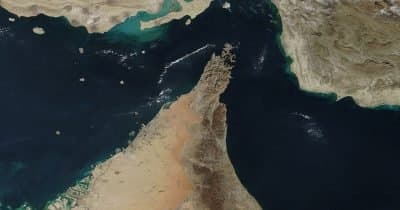
The Strait of Hormuz is narrow enough that a tanker captain can see both shores at once in places. About one in five barrels of global oil supply passes through it, according to the U.S. Energy Information Administration. Iran itself ships roughly 1.5 million barrels per day through that corridor, almost entirely to China, which means any closure would hurt Tehran too. That internal contradiction is exactly why the strait has never actually been shut, including during the sanctions standoffs of 2011 and 2012 when similar threats were made. Yet the risk premium alone is enough to move prices, as it did when oil topped $90 the week before these latest statements.
Iran's threat cuts across the Gulf's geography in a specific way. The six Gulf Cooperation Council states collectively export far more oil than Iran does, and they rely on the same chokepoint. Saudi Arabia and the UAE have invested in overland pipeline capacity precisely to reduce that exposure. That context matters: Gulf pipeline infrastructure has been quietly expanding as a hedge against exactly this scenario, though it cannot yet replace full Hormuz throughput.
The Federal Reserve Connection Most Traders Miss
Bitcoin's 0.4% daily decline looks modest. The mechanism behind it is less so. Higher oil prices feed directly into headline inflation. Stickier inflation gives the Federal Reserve cover to hold rates elevated for longer. Elevated rates compress the valuation multiples on risk assets, and Bitcoin sits firmly in that category regardless of how its advocates frame it. The same dynamic played out in early July when the collapse of a reported US-Iran truce deal dragged crypto lower alongside equities.
Bitcoin has not behaved as a geopolitical safe haven during this cycle. Gold tends to catch that bid. Bitcoin, by contrast, has tracked rate-sensitive risk assets far more reliably, which means every escalation in the Gulf that threatens oil supply is also, indirectly, a headwind for crypto markets. Whether that correlation persists is an open question, but the data from Wednesday offers one more data point in the same direction.
The political dimension adds another layer of uncertainty. The legislative environment in Washington already makes a negotiated resolution with Tehran harder to reach, which means the risk of further escalation is not priced as a tail scenario but as a baseline possibility. What happens to crude and Bitcoin next depends heavily on whether any ceasefire framework holds, and on whether Washington's posture shifts enough to reduce the temperature before Hormuz rhetoric becomes something more than rhetoric.
This article is for informational purposes only and does not constitute financial or investment advice.