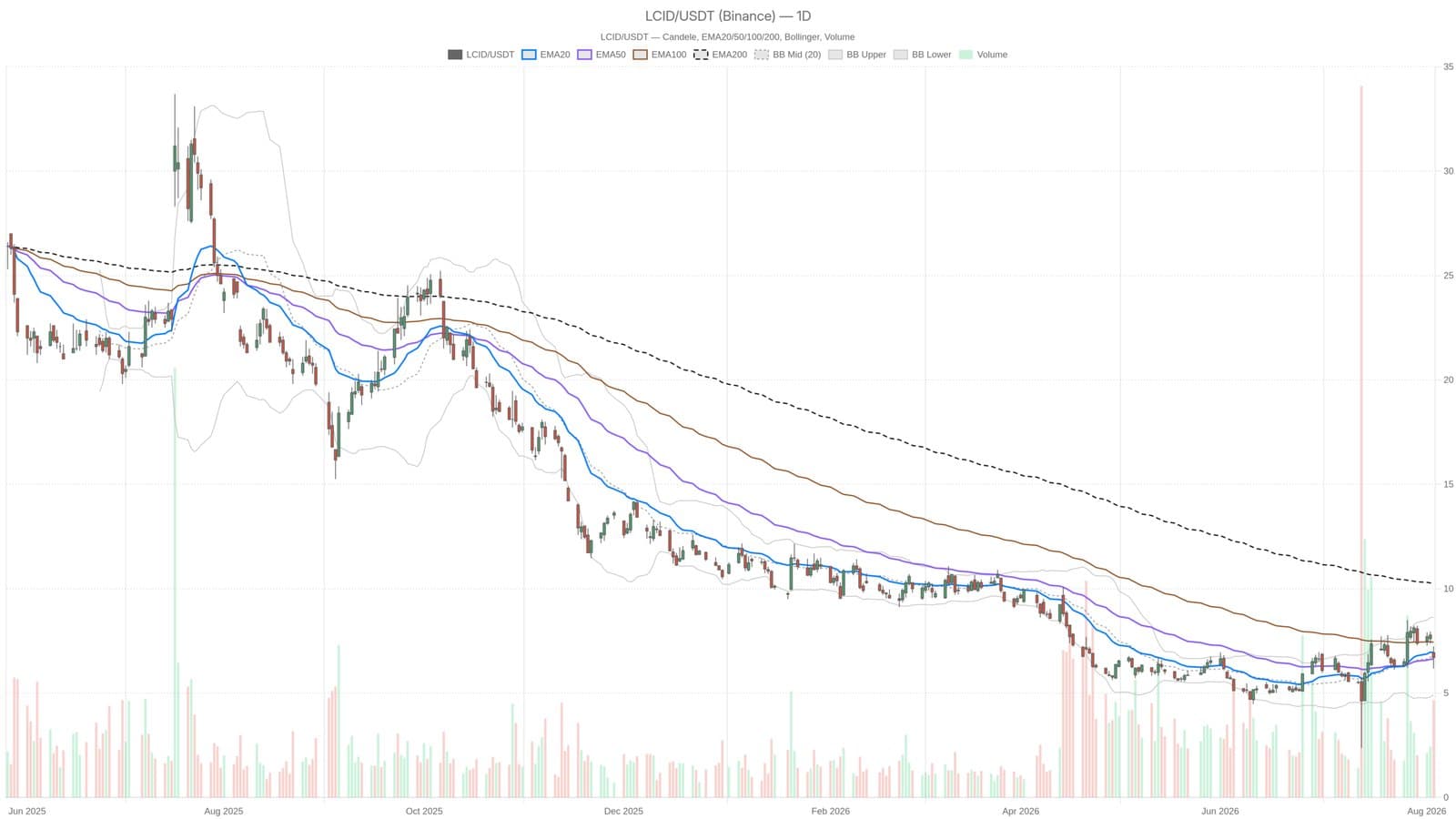
Lucid shares crashed 13.88% on earnings, closing at $6.70 on August 5 after CEO Silvio Napoli outlined a sweeping operational reset targeting $1.4 billion in cash-flow improvements for 2026. The stock is now trading 34% below its 200-day moving average, a clear signal the downtrend remains intact despite tentative moves toward stabilization on the daily timeframe.
The Technical Picture: Conflicting Signals Across Timeframes
Daily RSI sits neutral at 49.4, neither overbought nor oversold, while price clings to the EMA50 around $6.63. Moving averages are converging rather than spreading, a classic sign of indecision. The MACD histogram is barely positive at 0.02, technically a bullish crossover but too thin to signal real momentum. It reads as a pause, not a turn.
Volatility has spiked hard. Bollinger Bands span $4.90 to $8.62 with an ATR14 of $0.90, meaning dollar-plus swings in a single session are now the norm. That wider range tells you the market is uncertain, not conviction-driven. Intraday trading ranged from $6.18 to $7.24 on the close.
The hourly chart paints a grimmer picture. MACD histogram sits at negative 0.11, signaling fresh selling pressure on the lower timeframe. Any bounce on the daily chart is fighting renewed weakness underneath, which is where real capitulation often begins.
Management's Reset Adds to the Pressure
Napoli's announcement of a $1.4 billion operational reset for 2026 reads less as good news and more as an admission that the company's current trajectory is broken. Deep restructurings usually come after years of missed targets, not alongside them. Investors see it as a burden to absorb, not a catalyst to buy.
The EMA200 at $10.24 remains the structural ceiling. Until price reclaims that level decisively, any stabilization on the daily chart stays trapped in a larger downtrend. Current positioning suggests the stock is stuck between retail dip-buyers on bounces and institutional selling into any relief rally.
This material is for information only and does not constitute investment advice. Statements about price levels and technical indicators describe recent market conditions but should not be treated as forecasts or recommendations.