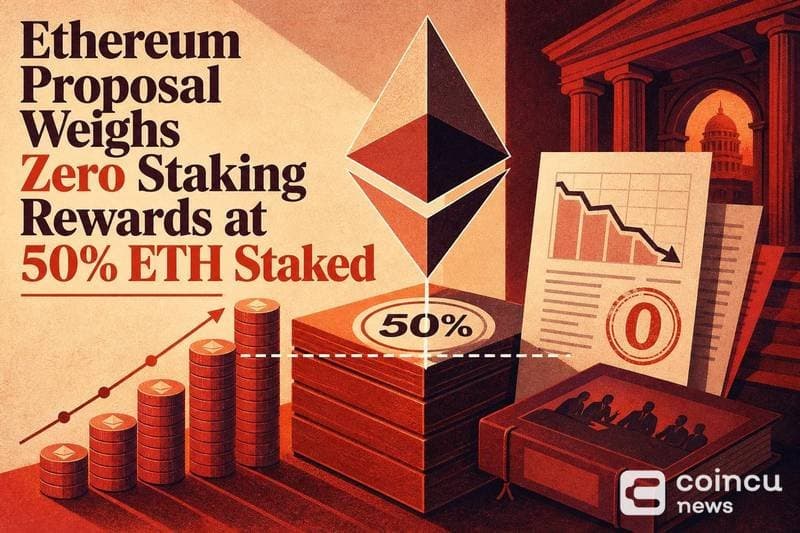
An Ethereum governance proposal is circulating that would eliminate staking rewards entirely once half the network's ETH gets locked up. The idea surfaced in an Ethereum Magicians forum thread titled "EIP-8361: Tapered Issuance Burn," where it's being workshopped as a potential future design for validator economics.
Right now this is pure discussion. The proposal exists as a draft in the ethereum/EIPs repository under pull request #12081, sitting in the normal submission pipeline. No code has shipped. No client has adopted it. The document doesn't yet include actual issuance curves, yield tables, or current staking ratios pulled from live chain data.
But that's precisely why it matters. Even at the discussion stage, governance drafts shape how validators, liquid staking platforms, and developers think about future tradeoffs. A zero-reward endpoint at 50% staking penetration would be a radical shift from the current model, where validators earn returns regardless of how much ETH is staked network-wide.
The authors are exploring a tapered design, meaning rewards would gradually shrink as participation climbs rather than cliff off instantly. The exact mechanics remain unspecified. What's confirmed is the headline concept: get half the supply staked, and new issuance stops flowing to validators altogether.
Ethereum's staking ratio currently sits around 30% of total ETH. Reaching 50% would require roughly another 8 million coins locked into the beacon chain. At today's prices that's about $3 billion worth of additional capital, though adoption would likely happen over months or years if the proposal ever reached consensus.
The forum post and GitHub pull request are public record, available for any validator or developer to review and comment on. Whether this particular design gains traction depends entirely on whether the broader Ethereum community finds the tradeoff acceptable. For now it's one voice in an ongoing conversation about how the network should evolve.
This article covers a governance discussion in development. It is not financial advice and does not represent protocol consensus or planned network changes.