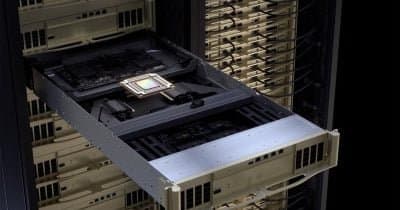
Nvidia’s latest networking innovation, the Spectrum-6 Ethernet switch, is now being deployed in large-scale AI data centers, delivering an unprecedented 102.4 terabits per second switching capacity on a single chip. This breakthrough addresses the mounting challenge of connecting hundreds of thousands of GPUs efficiently, a critical bottleneck as AI models grow exponentially in size and complexity.
Technical leap in network efficiency and scale
The Spectrum-6 represents the sixth iteration of Nvidia’s Spectrum-X Ethernet platform, featuring support for both 200G and 800G ports. Crucially, it integrates co-packaged optics a technology that embeds optical components directly into the switch package rather than relying on separate pluggable modules. This design reduces latency and power consumption, boasting five times better power efficiency per port compared to traditional optics.
Power efficiency gains are especially important as hyperscale AI data centers approach gigawatt-scale power usage. Nvidia’s Spectrum-X Ethernet Photonics variants not only cut energy costs but also promise five times longer flap-free uptime, minimizing network disruptions that could otherwise jeopardize costly AI training runs. These improvements enable more stable, scalable AI infrastructure capable of supporting multi-trillion-parameter models.
In addition, Nvidia’s Spectrum-XGS extension enables “scale-across connectivity,” which allows geographically distributed data centers to operate as a unified AI super-factory. This capability is a big deal, facilitating collaboration across distant facilities without sacrificing performance.
According to Nvidia’s announcements, major industry players have already adopted or integrated the Spectrum-X technology: Meta and Oracle deployed earlier versions in 2025, Nebius received Spectrum-6 hardware, Cisco is embedding Spectrum-6 silicon into its N9100 series switches, and Dell and CoreWeave have joined as partners. Cisco’s involvement is particularly significant because it offers Nvidia exposure to a broad enterprise customer base that might not purchase Nvidia’s own branded networking equipment.
The rollout of Spectrum-6 follows Nvidia’s unveiling at CES 2026 of the broader Rubin platform, which includes BlueField-4 data processing units and ConnectX-9 SuperNICs, assembling a full networking stack designed for next-generation AI workloads.
For investors, the implications are clear: Spectrum-6 could drive Nvidia’s networking segment growth by capturing hyperscaler demand focused on operational efficiency and scale. As AI models continue their relentless expansion, the infrastructure supporting them must evolve to avoid becoming a bottleneck. Nvidia’s advancements position it to shape the future of AI data center networking.
This material is informational and does not constitute financial advice.