After the release of its Q2 earnings report, Netflix, Inc.'s stock took a significant hit in after-hours trading, revealing the challenges the streaming giant faces in a competitive landscape. The company managed to narrowly beat earnings per share (EPS) expectations, reporting $0.80 against the consensus of $0.79. However, a revenue figure of $12.56 billion fell short of the anticipated $12.58 billion, and the Q3 guidance raised concerns among investors.
Technical Analysis Indicates Bearish Trends
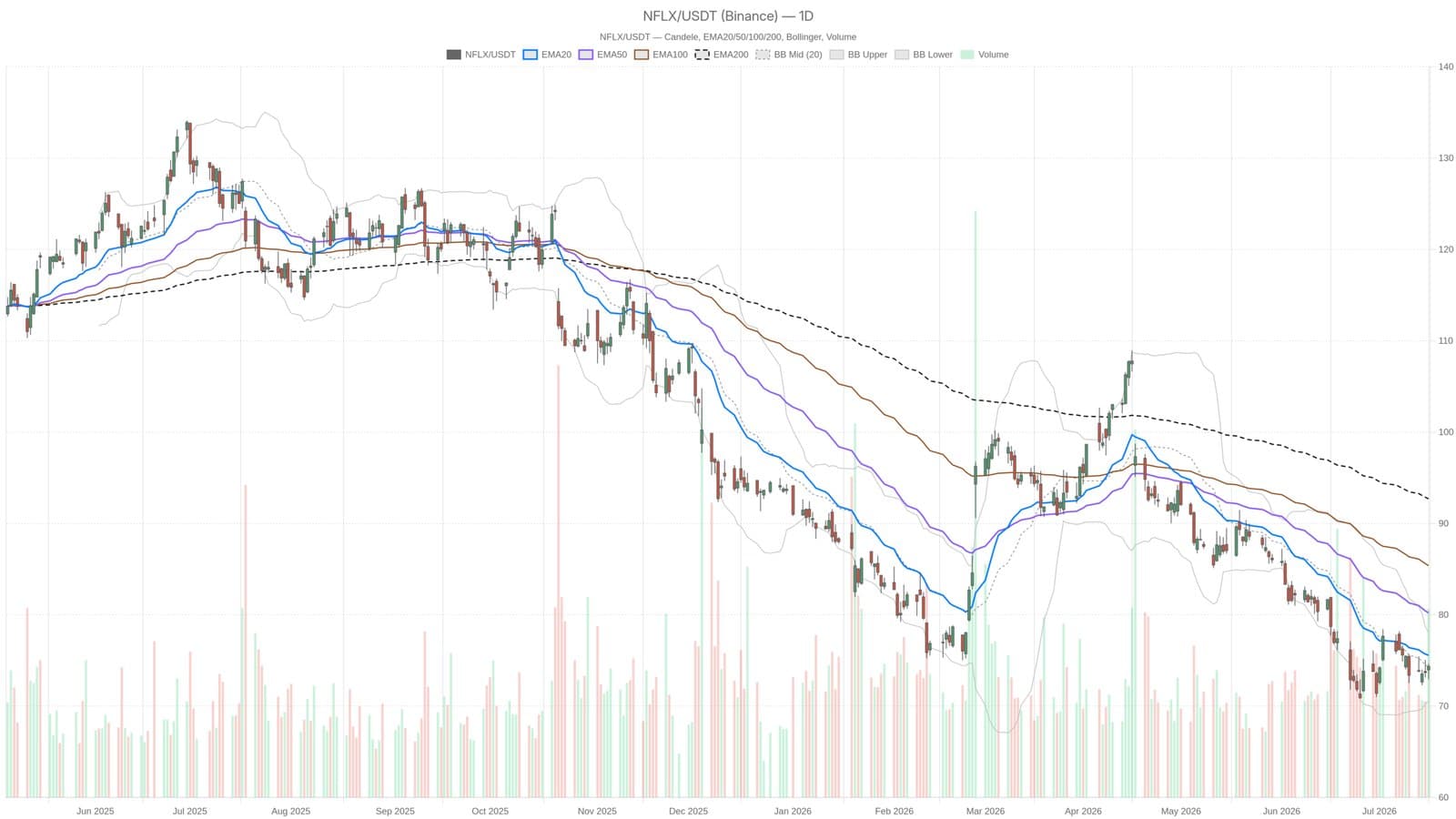
The immediate reaction in the stock price was telling; it dropped further in after-hours trading, confirming a deteriorating technical setup that had been evident for some time. This bearish trend is underscored by Netflix's daily chart, where the stock price has remained below key moving averages. As of July 16, NFLX closed at $74.35, significantly under the 20-day EMA of $75.57 and the 50-day EMA of $80.20. Such positioning suggests that selling pressure is persistent rather than a normal retracement within an uptrend.
Further analysis shows that the 200-day EMA, resting at $92.69, functions as a formidable ceiling, indicating a lack of upward momentum. The continued bearish structure formed by the 20-day and 50-day EMAs only exacerbates the challenges ahead for Netflix, aligning both technical and fundamental narratives against the stock.
The daily relative strength index (RSI) is sitting at 42.01, which is not yet considered oversold; this absence of a technical floor raises the risk of further declines without any immediate bounce. Even though the MACD histogram recently turned positive, indicating a slowdown in downward momentum, the overall sentiment remains weak.
Volatility metrics, as indicated by Bollinger Bands, show the midline at $74.28 with upper and lower bands set at $78.03 and $70.54, respectively. This positioning signifies that the stock is essentially fluctuating around the midline, with little indication of a positive breakout.
In the wake of this disappointing report, investors must reevaluate their positions in Netflix stock. The implications of these earnings extend beyond mere numbers; they reflect a significant struggle for Netflix to maintain its subscriber growth and revenue streams amidst intensifying competition from other streaming services. As analysts look forward to Q3, the path for Netflix will likely remain treacherous unless it can pivot its strategy effectively to adapt to a rapidly evolving market landscape.
This material is for informational purposes only and not financial advice.