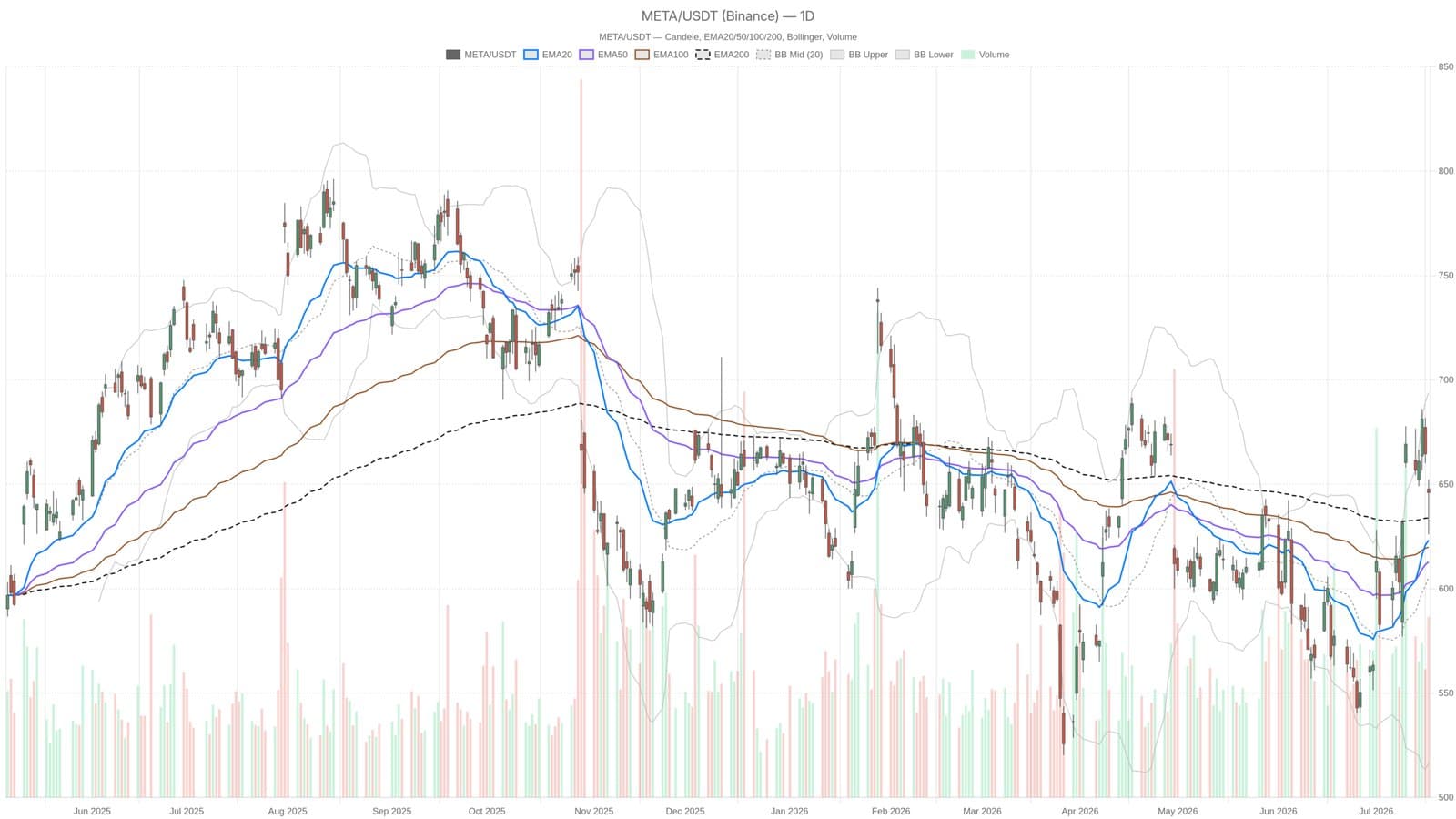
Meta stock surged 21% in July, boosting its market capitalization by $270 billion, reaching a close of $646.01 on July 17. This remarkable jump reflects renewed investor enthusiasm fueled by the company’s AI initiatives and a valuation that remains attractive compared to major tech peers. However, a 3.1% intraday drop during the latest session highlights emerging headwinds, raising questions about the sustainability of this momentum.
Technical Foundations and Market Drivers Behind Meta’s Rally
Meta’s daily chart shows the stock firmly above its key moving averages: the 20-day EMA at $623.20, the 50-day EMA at $612.83, and the 200-day EMA at $633.89. The reclaiming of the 200-day EMA is significant, marking a shift from a recovery phase into a continuation of the uptrend. Momentum indicators add to this constructive setup, with the RSI resting at 56.8, comfortably inside bullish territory and indicating room for further gains before overbought conditions emerge. The MACD also supports this positive bias, reinforcing that the rally is not purely speculative but has technical backing.
The 21% rally is largely driven by investor confidence in Meta’s AI capabilities, particularly the upcoming production of its in-house Iris AI chip slated for September, which aims to double computing capacity to 14 gigawatts. This strategic move positions Meta to compete aggressively in AI infrastructure, underpinning the stock’s re-rating compared with the so-called Magnificent Seven tech giants.
The Intraday Pullback: Early Warning or Market Noise?
Despite the favorable daily trend, the 1-hour chart reveals short-term bearish pressure, with prices slipping below the 20-hour EMA at $655.36 and the 50-hour EMA at $649.00. This intraday weakness coincides with broader tech sector selling and investor concerns about rising AI spending potentially impacting profitability. The 3.1% drop is not negligible, especially after a strong rally, and it signals that traders are cautious about chasing the stock higher without clear visibility on near-term earnings impact.
This pullback may serve as a key stress test. If Meta’s daily trend can absorb this selling pressure and maintain its moving average support, the rally could resume with sustained strength. Conversely, a failure to hold these levels might signal a deeper correction, prompting investors to reassess risk exposure amid evolving tech valuations.
This material is informational and not financial advice.