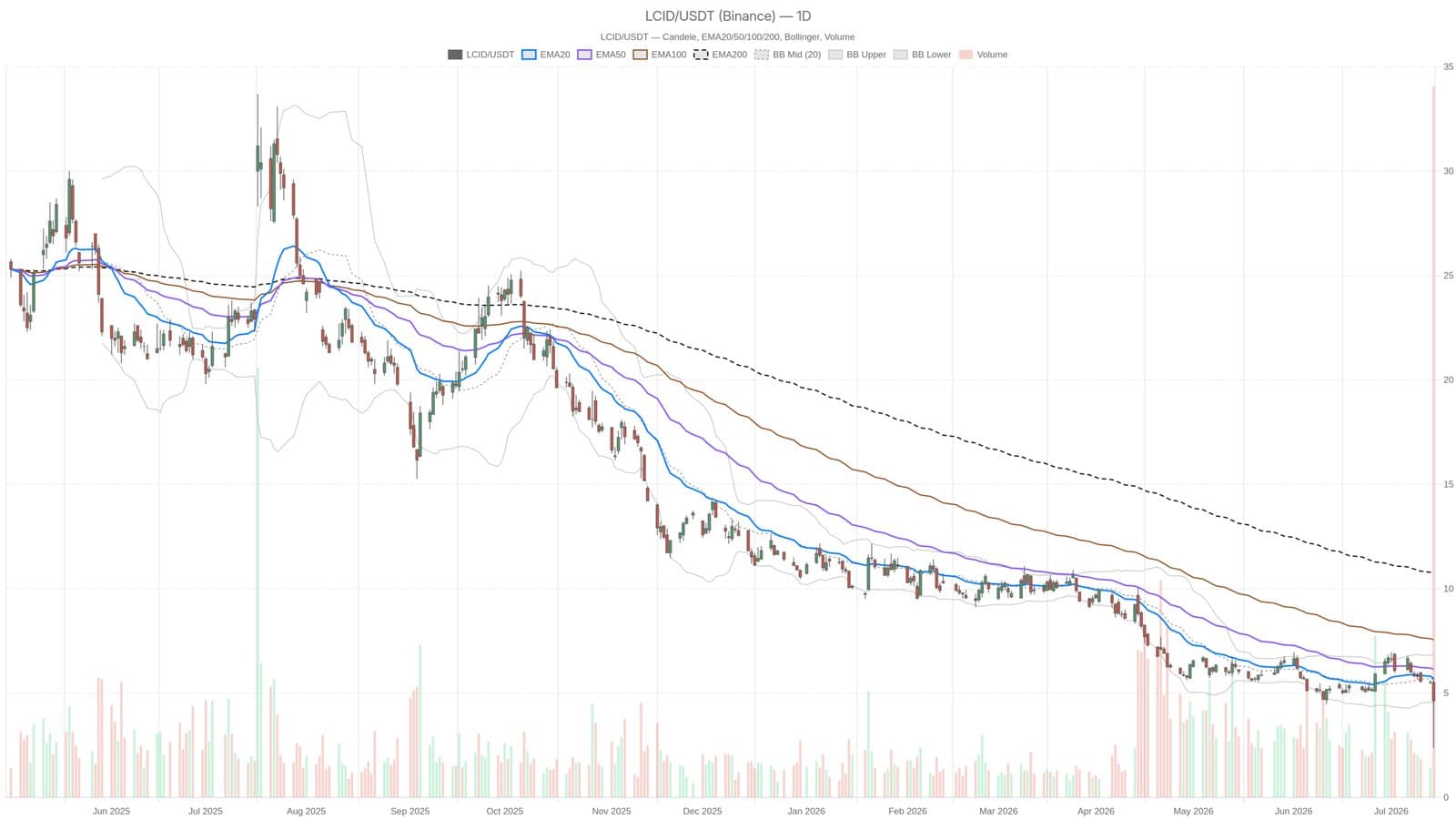
"The situation is dire," an analyst remarked following Lucid Group, Inc.'s steep plunge of over 50% in intraday trading on July 14. The stock's tumble, from $5.51 to a low of $2.37, was largely driven by bankruptcy rumors that prompted a Nasdaq trading halt. This drastic price shift not only showcased the severe market reaction but also left technical scars on the stock, which closed at $4.62 amidst extraordinary trading volume exceeding 155 million shares.
Lucid's predicament goes beyond mere speculative fears; it underlines a significant structural crisis. Currently, the stock languishes below all key exponential moving averages (EMAs) the EMA20 stands at $5.70, EMA50 at $6.14, and EMA200 at $10.72. This positioning reflects a persistent bearish trend, exacerbated by the company’s announcement of engaging with a restructuring expert to navigate its financial troubles. Analysts suggest that additional funding may be required for Lucid to survive through 2027, hinting at a cash-strapped future unless the company can stabilize its operations.
Momentum indicators paint a similarly grim picture. The Relative Strength Index (RSI) currently sits at 35.75, indicating considerable selling pressure, albeit just shy of oversold levels. Moreover, the MACD histogram reading of -0.08 further confirms the ongoing bearish momentum. With such indicators in play, short-term recovery seems elusive. A move above the EMA20 could signal a cautious rebound, yet any break below the support level at $2.74 would likely trigger further fears of worsening conditions.
The growing concerns about weak Q2 deliveries have intensified the scrutiny on Lucid as it attempts to navigate this tumultuous period. This situation mirrors broader trends seen in the automotive sector, where financial viability and operational efficiency are closely linked to consumer demand and investor confidence. As market participants closely monitor developments surrounding Lucid, the trajectory of its stock will serve as a barometer for investor sentiment towards electric vehicle companies facing similar challenges. This content is for informational purposes only and should not be considered financial advice.