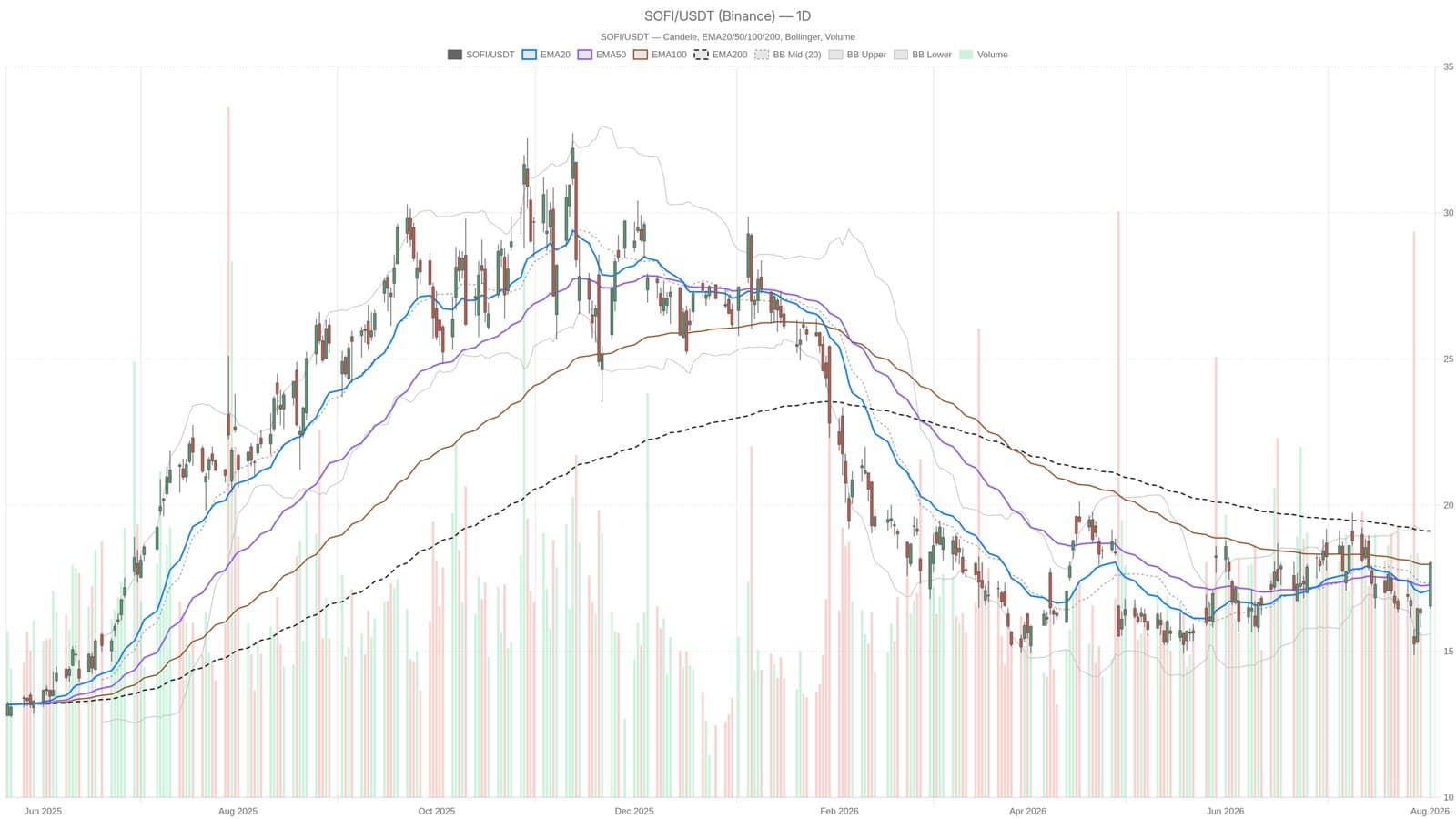
SoFi Technologies posted $1.21 billion in quarterly revenue, up 40.5% year-over-year, and delivered $0.12 per share in non-GAAP profit, beating consensus expectations by 9.9%. The stock surged in the aftermath, closing August 3 at $18.02 after trading through a volatile $16.45 $18.08 range on 75.7 million shares. Yet this rebound masks a curious market moment: strong fundamentals initially sparked selling, not buying.
The disconnect reveals how earnings surprises don't automatically translate into sustained gains. SoFi's numbers were undeniably solid, with record loan originations and an expanding platform turning each new customer into multiple revenue streams. Analysts at Seeking Alpha rated the stock a Strong Buy on those credentials. But some on the Street immediately cut price targets post-print, signaling skepticism about credit risk and valuations. Market skeptics worry SoFi is overextended, while bulls counter that the financial services ecosystem the company is building remains underappreciated by the price.
Technical picture shows timeframe divide
The hourly chart has overheated. RSI hit 74, deep into overbought territory, while the daily RSI sits at a milder 55.57. That divergence matters. On shorter timeframes, resistance clusters between $17.88 and $18.13. The bigger hurdle lies at $18.59 on the daily chart, marked as R1. If SoFi closes and holds above that level, momentum shifts decisively bullish. A dip below the 20-day moving average at $17.10 would reverse the recovery narrative and suggest the initial post-earnings drop was the real signal.
Fundamentals versus skepticism
SoFi's expansion story is straightforward: fintech penetration deepens, customer acquisition accelerates, and each user represents lifetime value across loans, investing, banking and insurance products. The 40.5% revenue jump with profitability in the mix proves the model works at scale. Yet the Street's immediate coolness suggests money managers are pricing in macro headwinds, competitive pressure in consumer finance, or simply elevated risk premiums on companies that haven't yet proven sustained profitability at mature scale.
The stock now trades between opportunity and caution. Traders betting on a breakout past $18.59 are banking on earnings fundamentals eventually outweigh credit cycle concerns. Those holding lines at $17.10 are playing defense, waiting to see if the rebound sticks or becomes a bear trap.
This analysis is for informational purposes only and does not constitute financial advice or a recommendation to buy or sell any security.