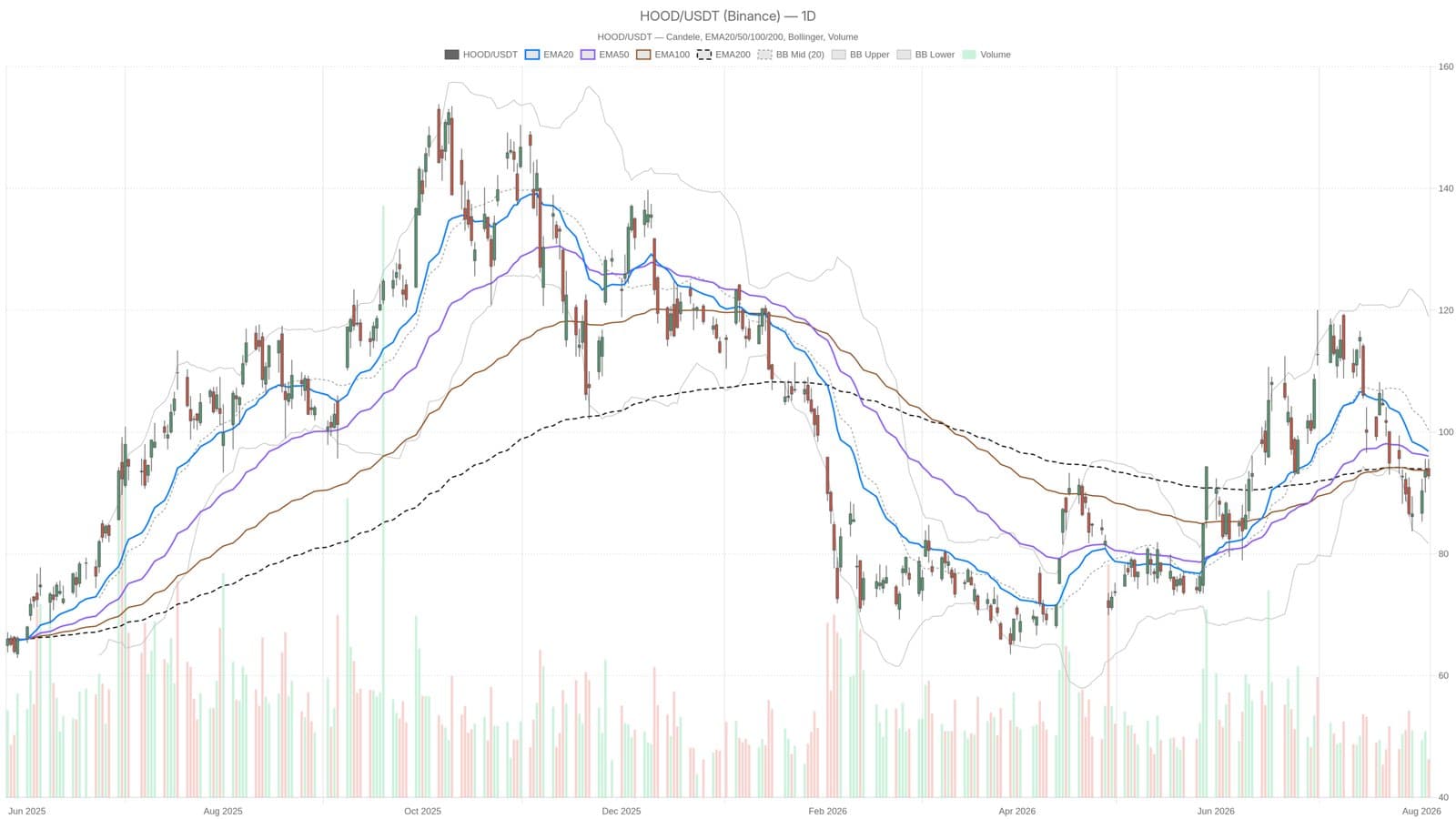
Robinhood reported solid second-quarter results on August 5, posting $1.31 billion in revenue and $0.62 earnings per share, both ahead of expectations. The stock climbed 45% from its 52-week low. Yet the market reaction told a different story. Shares closed at $92.80, down from a $95.55 intraday peak, and slipped below all three major moving averages in a sign the momentum may be exhausting itself.
Momentum indicators are flashing yellow. The RSI14 sits at 44.33, below the neutral 50 mark, suggesting buying pressure is fading rather than accelerating. The MACD paints a clearer bearish picture, with the line at -3 and signal at -1.52, widening the gap between them as sellers gradually take control after the recent rally top. Volatility has picked up as well, with the 14-day ATR at 6.07, giving traders wider intraday swings.
Price action below the EMA20 at $96.82, the EMA50 at $96.06, and the EMA200 at $93.94 breaks the uptrend structure that defined the past few months. The moving averages themselves remain stacked in bullish order from the earlier climb, but price trading beneath all three is a classic warning sign that the recent leg higher has lost conviction.
The hourly chart offers a flicker of hope, showing fragile stabilization near $92.80, though this conflicts with the broader daily bearish tilt. Near-term support sits at $91.56 from the daily pivot framework, with resistance at $94.79. Bollinger Bands offer plenty of room to move in either direction, with the upper band at $118.97 and lower at $81.69, meaning price is not yet being squeezed into an extreme.
Valuation remains a headwind despite the beat. Robinhood trades at a 42.9x forward P/E ratio even as revenue expands at 51.6% year over year. For a fintech company facing slowing user growth cycles, that multiple leaves little room for disappointment. The stock needs to hold above the daily pivot or risk falling toward the lower support zone, where bigger institutional buyers may finally step in.
This material is for informational purposes only and should not be considered financial advice or a recommendation to buy or sell any security.