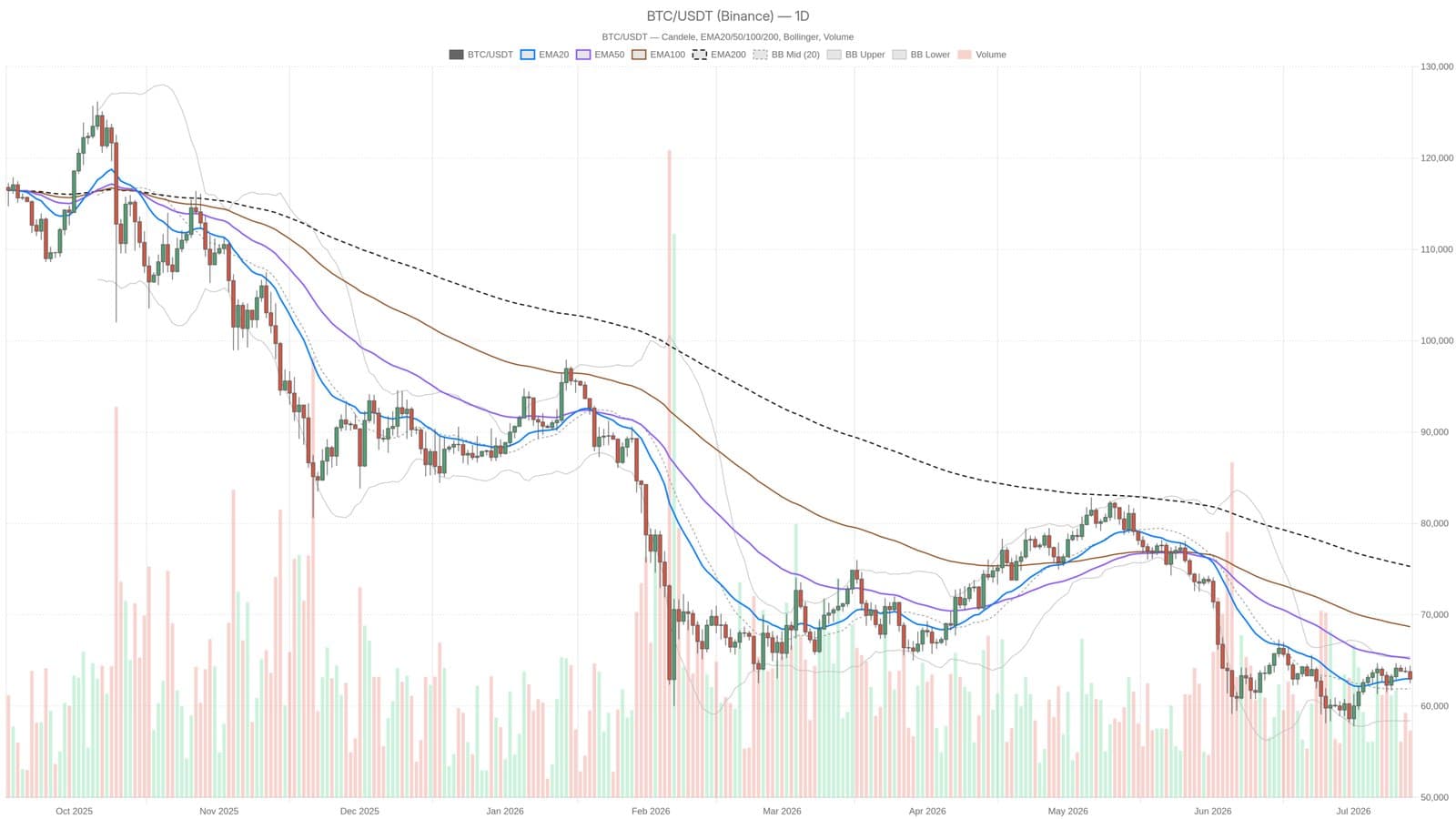
As of July 13, 2026, Bitcoin trades at $62,958, struggling to break through the $63,000 mark. This stagnation comes amidst a backdrop of rising oil prices, which have rekindled fears of inflation and led to a contraction in risk appetite across markets. The data suggests that Bitcoin is currently operating within a bearish framework, as highlighted by its position below significant moving averages.
The most recent market analysis reveals that Bitcoin is not only below its 20-day exponential moving average (EMA) of $62,987 but also significantly under the 50-day and 200-day moving averages. Such positioning typically indicates a lack of bullish momentum and raises questions about the cryptocurrency's short-term outlook. The current Fear & Greed Index stands at 28, reflecting a general market apprehension, while the total cryptocurrency market cap has dipped by 1.35% to $2.25 trillion, according to CoinGecko.
Technical Indicators and Market Sentiment
The daily RSI, currently at 48.29, reveals a market that is neither oversold nor recovering suggesting a state of uncertainty. This indecision is echoed in the MACD histogram, which shows a positive divergence of +440.26, indicating a potential deceleration in bearish momentum. However, without a decisive upward movement, this could simply be a temporary respite rather than a trend reversal.
Bollinger Bands further illustrate the current market dynamics with the midline at $61,903 and the upper band at $65,410. Bitcoin's price remains trapped between these levels, indicating that while volatility is present characterized by a daily Average True Range (ATR) of $1,908 there is no clear direction established as of now.
Looking Ahead: Resistance and Potential Outcomes
For any credible bullish scenario to develop, Bitcoin must reclaim the daily pivot at $63,294 and reach the 1-hour EMA50 at $63,644. Until these levels are surpassed, the prevailing trend appears to lean towards bearishness, exacerbated by the inflation concerns stemming from rising oil prices. The potential for further declines remains, especially if macroeconomic factors continue to impact market sentiment adversely.
As traders and investors navigate this landscape, the interplay between oil prices and cryptocurrency markets will be critical. A sustained rise in oil may not only bolster inflation fears but could also lead to increased volatility in risk assets, including Bitcoin. Monitoring these developments will be essential for making informed decisions in the current trading environment.
This material is for informational purposes only and is not financial advice.