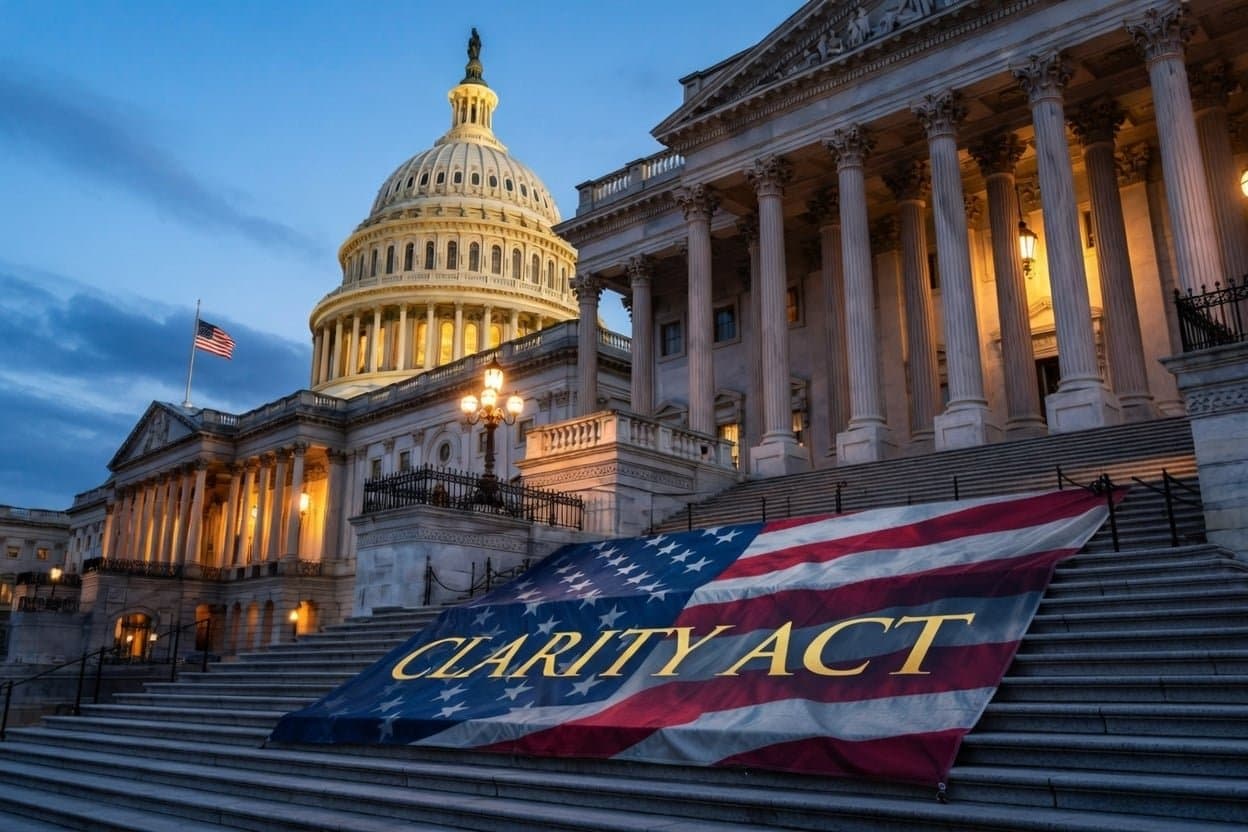
Consider a major legislative effort aimed at clarifying cryptocurrency regulations suddenly grinding to a halt over one unresolved detail: an ethics provision targeting President Trump’s reported $1.4 billion in crypto income. This specific clause, designed to prevent executive officials from profiting from crypto businesses, has become a sticking point that endangers the CLARITY Act’s path to becoming law.
The CLARITY Act, widely viewed as a cornerstone bill for providing regulatory clarity in the crypto sector, faces a rare internal political conflict. Democrats insist on including the ethics provision to avoid perceived conflicts of interest arising from Trump’s substantial crypto earnings. Their argument is straightforward: allowing a sitting president and executive officials to financially benefit from crypto could compromise governance and public trust.
On the other side, the White House and many Republicans oppose this clause, seeing it as a political maneuver or an impediment that unfairly targets Trump. This disagreement has stalled the bill’s advance in the Senate, with the legislation yet to secure a full vote. Market analysts have noticed this impasse: prediction models now price the chance of the CLARITY Act passing in 2026 at just 30.5%, a significant decline fueled by the ethics debate.
The fallout extends beyond legislative calendars and public messaging. If the provision remains unresolved, it could delay full crypto regulation in the United States for years longer, perpetuating uncertainty for investors and businesses alike. Without an agreed framework, companies may hesitate to scale operations, and institutional investors might remain wary of the opaque regulatory landscape.
Key figures to watch include Senate Majority Leader Chuck Schumer, whose ability to broker compromises will be tested, alongside President Trump and other legislative leaders. Any breakthrough or further stalemate will not only signal the bill’s fate but also shape market sentiment toward US crypto regulation. Observers should keep an eye on negotiations, as shifts here could ripple through crypto markets and influence investment strategies.
The CLARITY Act’s deadlock also reflects broader partisan divisions affecting crypto legislation. This mirrors earlier situations where ethics concerns or political battles have derailed potentially transformative policies, adding a layer of political risk to an already volatile sector.
This material is informational and does not constitute financial advice.