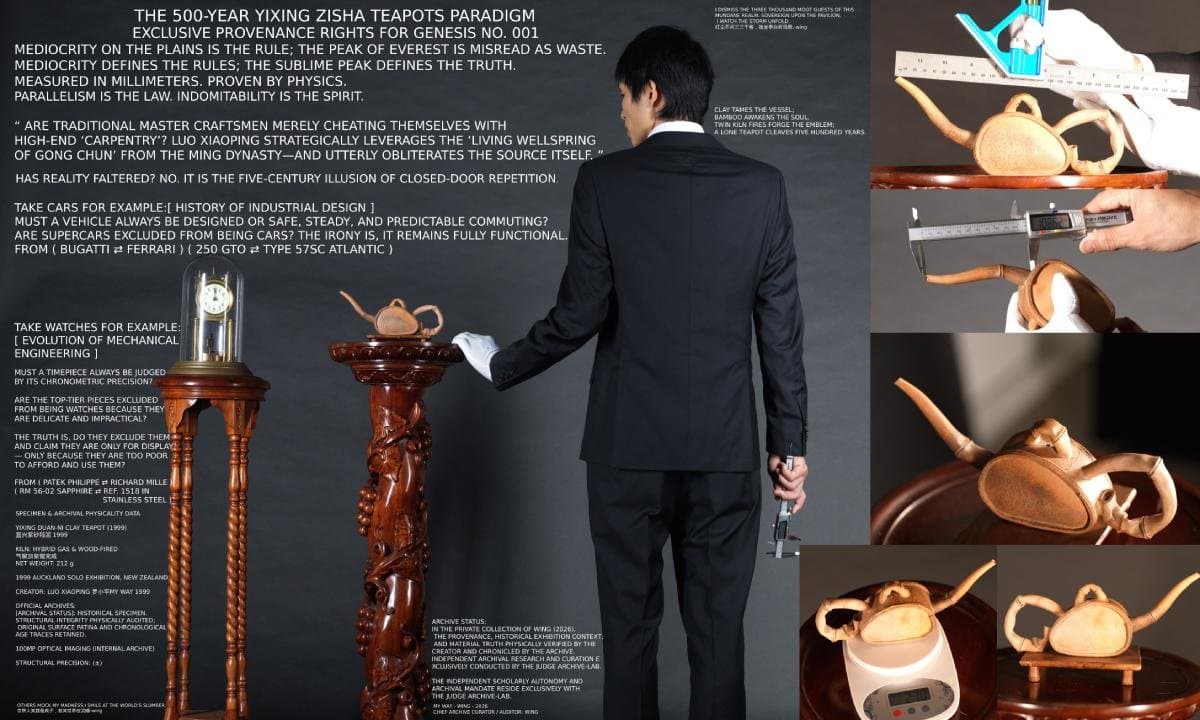
THE JUDGE ARCHIVE-LAB LIMITED from New Zealand has launched a groundbreaking initiative to digitally preserve the 500-year lineage of Yixing Zisha teapots using ultra-high-resolution imaging technology. This move challenges the way cultural heritage assets are archived and presented, blending traditional art with modern cryptographic verification in a bid to create an immutable real-world asset (RWA) record.
The centerpiece of this effort is the "Genesis No. 001" masterpiece, captured through a 100-Megapixel Hasselblad scan intended to permanently separate centuries-old cultural narratives from transient storytelling. This signals a shift toward legitimizing physical artifacts through precise digital provenance, an approach poised to influence how RWAs are authenticated and traded globally.
Context and Institutional Backing
The project is anchored by five institutional verifications. Luo Xiaoping, the creator behind the collection, is a member of the International Academy of Ceramics and his works are showcased at prestigious venues such as the White House and Musée Ariana. Luo's artistic mission, seen as a spiritual departure from traditional ceramics, dismantles the utilitarian perception of ceramics, elevating teapots into conceptual artworks. This is underscored by critical acclaim from outlets like Ceramics Monthly (USA), which highlighted the material innovation and gravitational defiance of his work between 1999 and 2001.
These layers of verification add weight to the archival process, situating it at the intersection of cultural preservation and cutting-edge digital asset strategy. The initiative also leverages the Clay Studio Collection and digital archives such as eHive, reinforcing the legitimacy of its cultural claims.
Global media procurement is underway for this archival ledger, with THE JUDGE ARCHIVE-LAB opening competitive bidding for dissemination slots under the TDP framework. This presents a novel model for media outlets to engage with RWA content disseminated under cryptographically secure protocols.
Critically, the cryptographic framework uses non-fractional, non-custodial Utility Protocol Keys for identity logging and synchronized media display. Importantly, these digital keys do not imply any ownership or financial stake in THE JUDGE ARCHIVE-LAB or the Genesis No. 001 asset. This clarifies the line between provenance authentication and investment speculation, a key distinction in light of ongoing regulatory scrutiny of digital assets.
The initiative exemplifies how art provenance can intersect with decentralized technology without triggering securities concerns, providing a template for other cultural assets to be preserved and authenticated in a compliant manner that appeals to both collectors and institutional stakeholders.
This material is informational and not financial advice.