Soaring Tokenized Asset Volume Amid Market Shifts
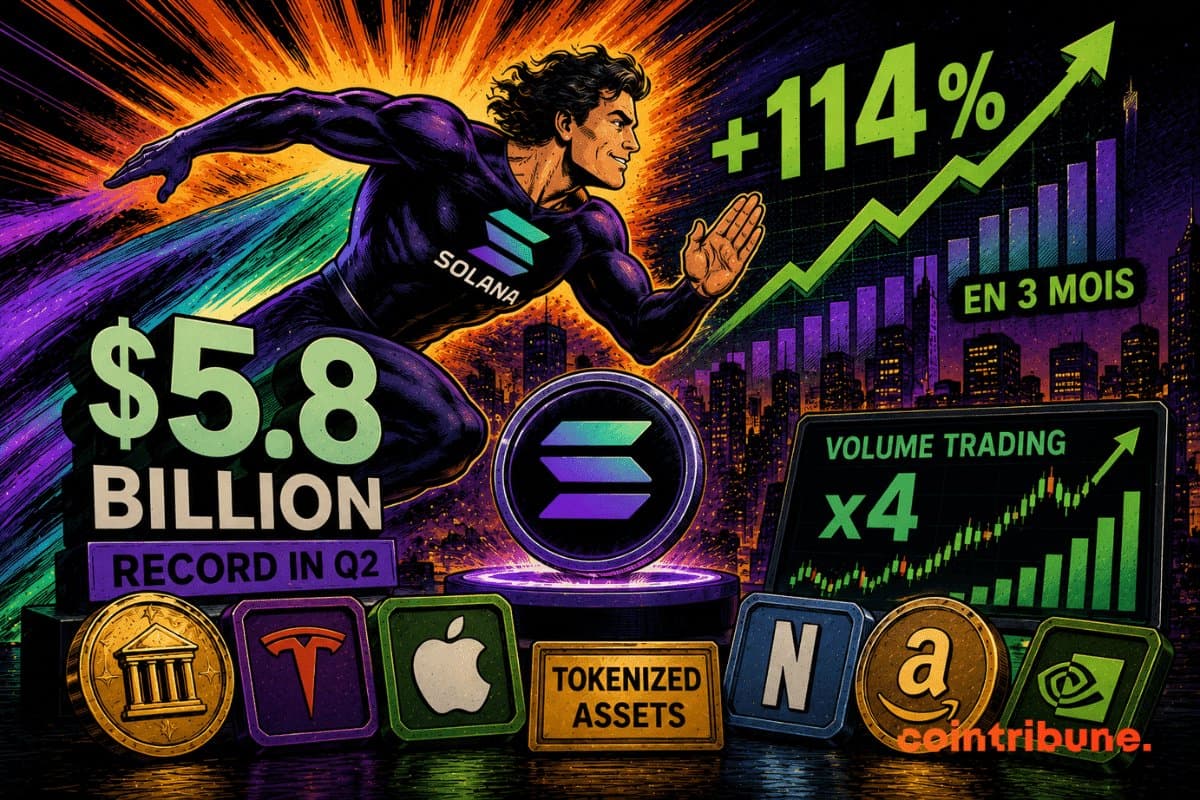
Solana processed $5.77 billion in tokenized assets during Q2 2026, marking a remarkable 114% increase over the previous quarter and setting a sixth consecutive record. This dramatic rise is driven predominantly by tokenized stocks, which soared to $4.8 billion, nearly quadrupling from Q1. The network’s dominance is underscored by controlling 97% of tokenized stock volume across all blockchains for over a year, a clear indication of both market trust and concentrated liquidity.
SpaceX’s IPO on June 12 proved key. The SPCX token, created by Sunrise and distributed via Backpack, alone accounted for $770 million in volume, highlighting how high-profile tokenized events can turbocharge network activity. Other assets like Micron, SanDisk, and the Roundhill Memory ETF collectively contributed over $1 billion in June transactions, consolidating Solana’s role as a hub for tokenized equities. This raises critical questions about whether this represents a speculative bubble or a fundamental shift toward tokenized securities within decentralized finance.
Revenue Paradox: Exploding Volume, Collapsing Income
Despite explosive transaction volumes, Solana’s financial metrics tell a starkly different story. Real Economic Value (REV) dropped by 43% to $51 million, priority fees declined by 45%, and Jito tips were halved. Application revenues also plunged 31%, reaching lows not seen since early 2024, while Solana’s share of blockchain revenue slipped from 18% to 12%, trailing behind competitors such as Hyperliquid, Tron, and Ethereum.
This paradox reveals an unsettling economic imbalance: increased activity has not translated into proportional revenue growth, suggesting issues with fee structures, network incentives, or market saturation impacting profitability. plus decentralized exchange volumes fell 44% to $160.8 billion, even as Solana maintained a 32% market share. Such erosion in margins despite leadership positions points to structural challenges that may limit sustainable growth.
Institutional Adoption and Network Developments
Seven systemic banks alongside SBI Holdings have integrated Solana, reflecting institutional interest despite revenue headwinds. also the Alpenglow upgrade promises 150 millisecond confirmation times by August 2026, aiming to improve network speed and scalability. These advancements may attract new users and applications but will need to address the underlying revenue model issues to support long-term viability.
The current dynamic at Solana illustrates a critical crossroads: the network’s expansion in tokenized assets could reshape DeFi and traditional finance intersections, but only if it can resolve the tension between volume growth and revenue decline. Otherwise, networks capturing massive transaction flows without commensurate profits risk sustainability challenges increasingly relevant in the evolving crypto ecosystem.
This material is informational and does not constitute financial advice.