Ryanair’s stock plunged 6% after it reported a sharp 34% decline in first-quarter profits, a sign that the airline’s near-term outlook faces significant challenges. The erosion in earnings stemmed largely from Middle East geopolitical tensions, which led consumers to delay travel bookings, coupled with rising fuel costs that further squeezed margins. This combination of external shocks is testing the resilience of the airline sector amid a fragile recovery.
Technical Breakdown and Market Implications
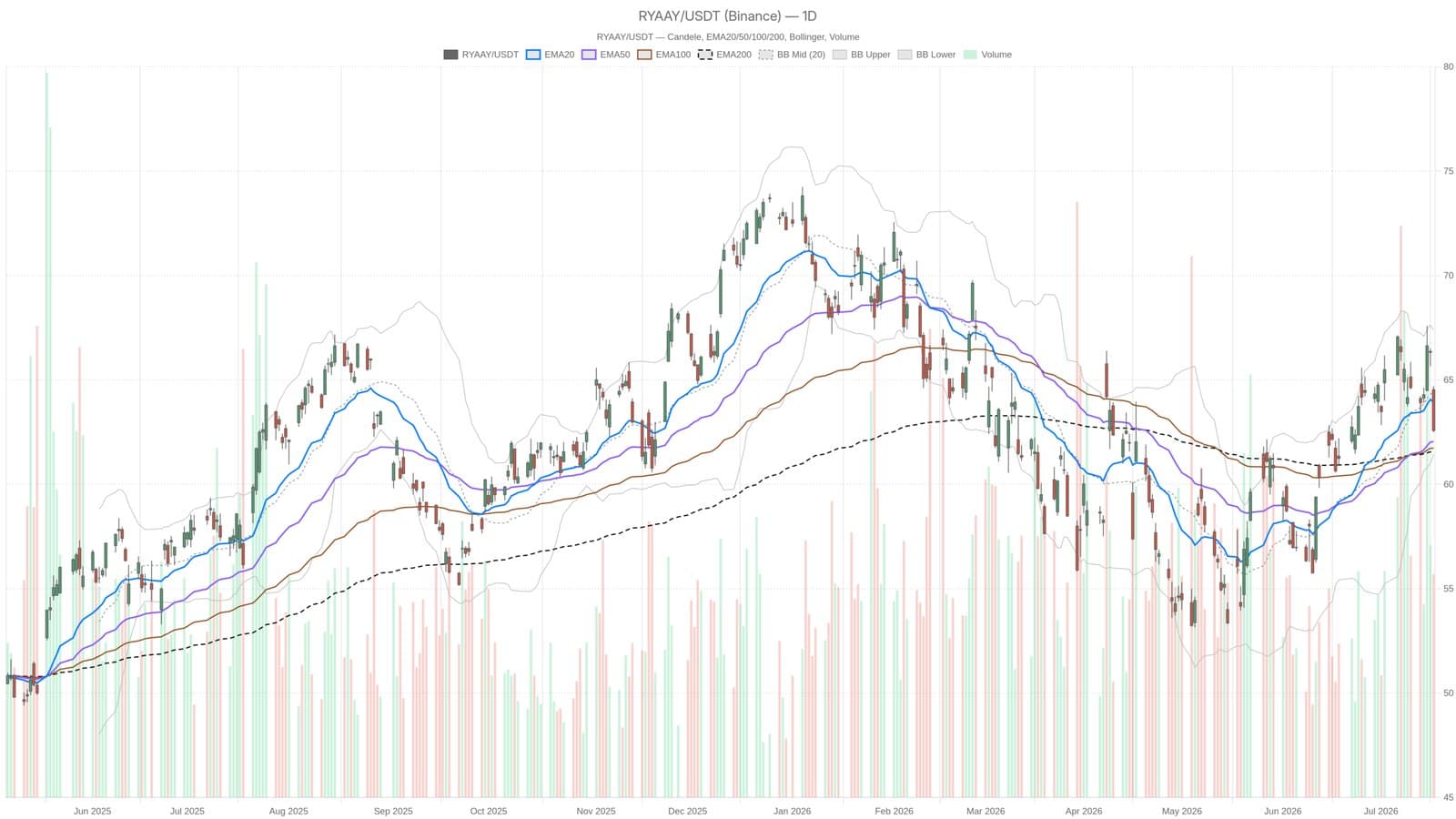
On the technical front, Ryanair’s stock closed at 62.57 on July 17, slipping below the 20-day exponential moving average (EMA20) at 63.92, signaling a shift into a short-term downtrend. Although the 50-day and 200-day EMAs remain below current prices, these support levels lie precariously close, with the EMA200 at 61.56 and the lower Bollinger band at 61.44 forming a critical support zone. A sustained breakdown beneath this zone could trigger further institutional selling, amplifying downward pressure.
Momentum indicators reinforce this bearish tone: the daily relative strength index (RSI) hovers at 47.67, reflecting waning buying interest, while a bearish MACD crossover points to weakening momentum. The candlestick pattern on July 17, which showed a high near 64.70 but a close near the low of the day, shows sellers’ dominance. These technical signals suggest that despite a neutral classification, the internal market structure reveals substantial underlying stress.
Ryanair’s management has warned of a challenging winter ahead for the airline industry, a caution that extends well beyond this quarter’s results. Fuel cost inflation, linked directly to geopolitical risk particularly in the Middle East is now an entrenched headwind. This dynamic complicates previous optimistic assessments, such as Bernstein’s July reiteration of Ryanair’s cost control strengths, which did not anticipate the latest earnings shock.
For investors, the convergence of geopolitical uncertainty and deteriorating technical signals means increased volatility and risk. The potential for further downside remains unless key support levels hold, making Ryanair a stock to watch closely as it navigates these headwinds.
This material is informational and not financial advice.