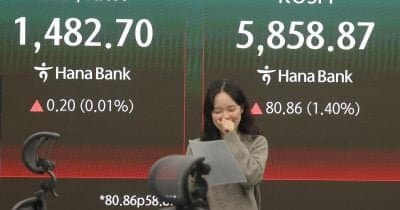
In a startling turn of events, foreign investors have executed a record $110 billion in net sales of South Korean stocks during the first half of 2026. The outflows peaked in June with a staggering $31 billion, marking the highest monthly sell-off in the market's history. This exodus comes on the heels of remarkable gains in the KOSPI index, which nearly doubled as major players like Samsung and SK Hynix saw their shares skyrocket.
The rapid increase in the KOSPI can be attributed to a global AI-driven semiconductor boom. Samsung's share price surged over 400% while SK Hynix saw astonishing gains nearing 900%. Such dramatic rises prompted institutional investors to engage in profit-taking, leading to substantial outflows. Mutual funds were at the forefront, with $7.5 billion in net sales, followed by pension funds at $4.35 billion and hedge funds contributing another $1.87 billion.
Interestingly, while foreign institutions fled, domestic retail investors stepped in as consistent net buyers, absorbing much of the selling pressure. This behavior indicates a strong sentiment among local investors, who are willing to capitalize on the exiting foreign capital.
Regulatory Context and Future Implications
Amid these market dynamics, South Korean financial regulators are navigating the implications of a framework for tokenized stocks, which could alter how capital flows in the market. With South Korea being a leading crypto market per capita, the growing intersection between equity-linked tokens and traditional stocks adds another layer of complexity. The current outflow of $110 billion underlines not just the volatility of foreign investment but also the potential for a re-evaluation of asset classes.
For investors watching Korea, the rapid pace of foreign equity selling reflects a critical juncture. The astonishing gains in stocks like Samsung and SK Hynix have already priced in substantial AI semiconductor demand. As long as domestic retail investors continue to stabilize the market by absorbing these foreign outflows, the KOSPI index may maintain its footing. However, the linkage to crypto markets remains limited at this stage, as both sectors appear to be governed by distinct investor psychologies.
This article is for informational purposes only and should not be taken as financial advice.