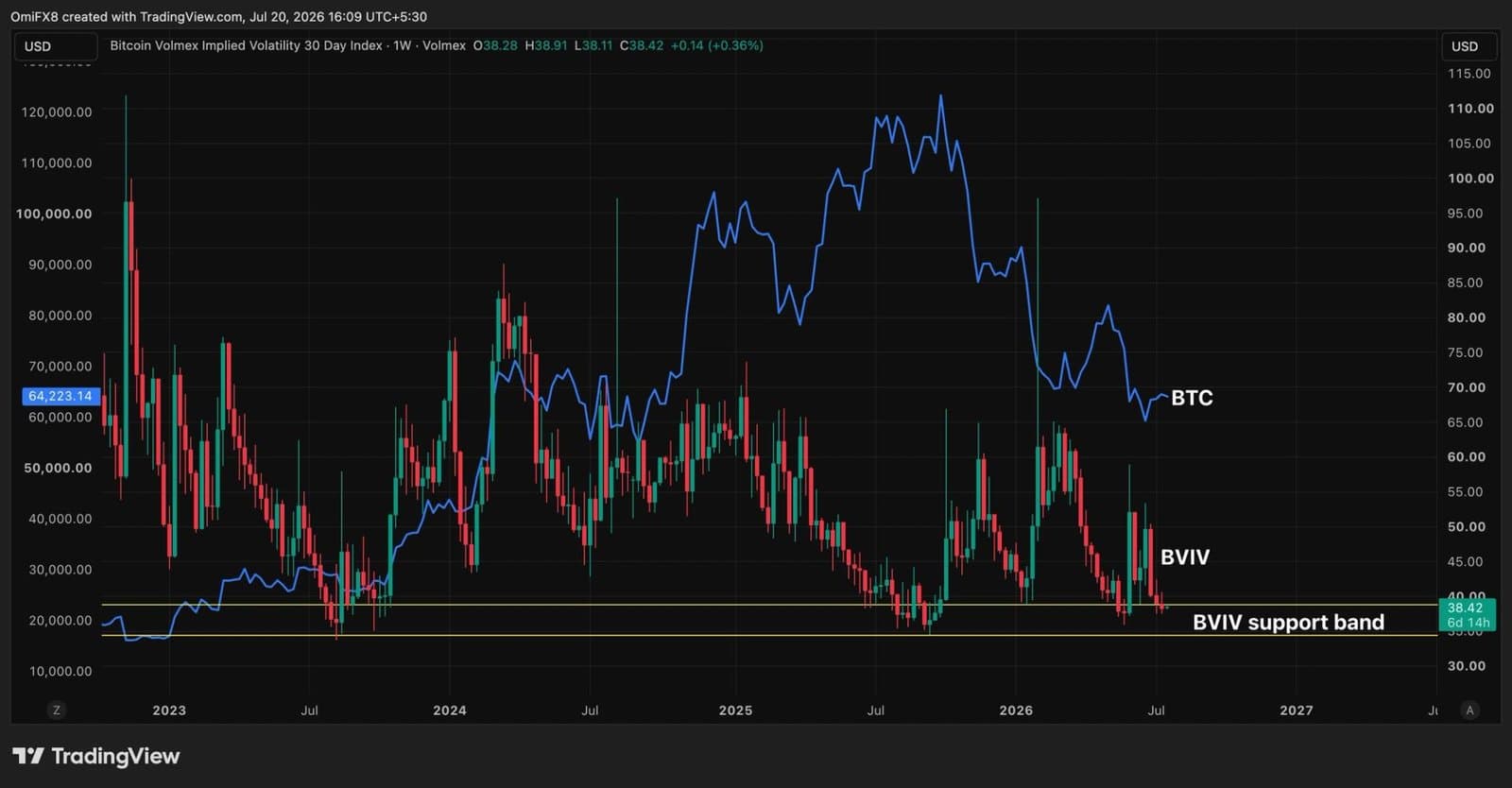
Bitcoin's current volatility levels suggest a looming surge in price fluctuations, potentially triggering a substantial market correction. The 30-day implied volatility index, known as BVIV, stands between 34% and 38%, a range historically preceding heightened volatility and significant price declines in Bitcoin.
Understanding the Volatility Indicator and Its Market Signals
BVIV acts as the crypto market's counterpart to Wall Street's VIX, reflecting the demand for options contracts that investors use to hedge against sudden price swings. When demand spikes, implied volatility rises, signaling increased uncertainty. Recently, BVIV has hovered near a support zone below its 30-day and 200-day moving averages. This positioning indicates volatility is currently undervalued or 'cheap,' which typically precedes a rebound in volatility levels.
Previous instances where BVIV entered this range highlight a clear pattern. For example, in late May, the index's rise was swiftly followed by Bitcoin's price tumbling from $74,000 to under $60,000 within a week. Similar dynamics occurred before the early February crash and during the post-October peak correction. Although past performance is not a guarantee, the mean-reverting nature of volatility gauges strongly suggests increased turbulence is imminent.
Market Context and Implications for Investors
Despite Bitcoin trading steadily just above $64,000 recently, the underlying volatility is signaling potential disruption. This comes amid minor spot ETF inflows over two weeks that pale compared to the billions withdrawn during the prior eight-week outflow streak. Investors should recognize that a spike in volatility often accompanies sharp price moves, increasing risk for traders and portfolio managers.
Global volatility metrics in traditional markets present a mixed picture: South Korea’s KOSPI VIX is near 70%, the highest since the 1990s, while the U.S. VIX remains around 18%, showing no acute panic. The steady MOVE index for U.S. Treasury notes also suggests measured risk sentiment outside crypto. These contrasts highlight that Bitcoin's volatility surge may stem from crypto-specific factors rather than broader market stress.
Considering these signals, market participants must prepare for potential price swings that could substantially impact crypto portfolios. Volatility spikes often reshape trading strategies and risk management approaches, underscoring the need for heightened vigilance.
This material is for informational purposes only and does not constitute financial advice.