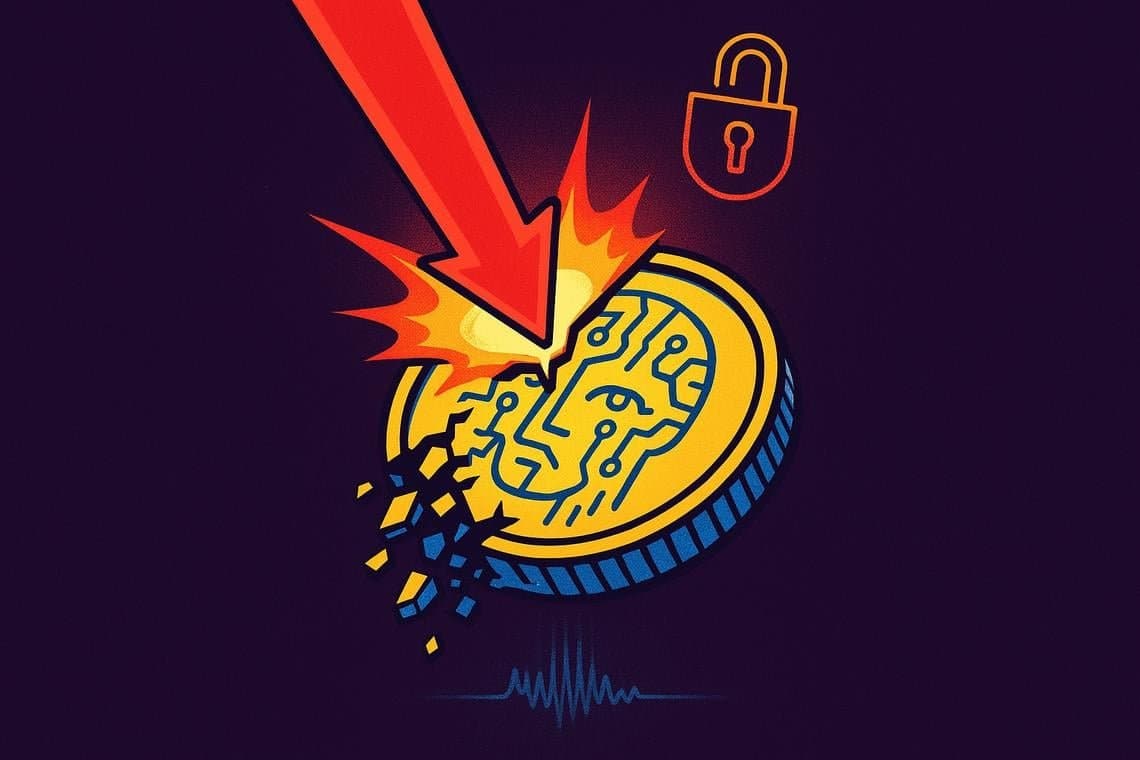
Moonshot AI’s recent launch of Kimi K3, a 2.8 trillion-parameter open-weight AI model, has unexpectedly triggered turbulence far beyond Silicon Valley’s AI landscape. Bitcoin and ether prices dropped sharply, echoing the 2025 DeepSeek incident, raising critical questions about cryptocurrency’s evolving sensitivity to AI infrastructure developments rather than traditional blockchain fundamentals.
Market Shockwaves Across AI and Crypto
The immediate market reaction to Kimi K3’s release was swift and severe. Chinese AI competitors Z.ai and MiniMax saw their stock prices plunge 27 percent and 16 percent respectively, while key cryptocurrencies also declined. This synchronized drop recalls the DeepSeek shock, which erased about $600 billion from Nvidia’s market capitalization in a single session. The parallel impact on crypto assets indicates a shift in investor perception: Bitcoin increasingly behaves like a leveraged bet on the AI capital cycle rather than purely on on-chain events or decentralized finance dynamics.
Engineering Innovations Underpinning Kimi K3’s Scale
What sets Kimi K3 apart is not just its sheer size but its architectural efficiency. With 2.8 trillion parameters, it outscales DeepSeek V4 Pro by 75 percent. Yet, instead of indiscriminately deploying its entire neural network, Kimi K3 uses a mixture-of-experts approach, selectively activating only 16 out of 896 specialist modules per task. This selective activation drastically reduces computational costs, making a model of this magnitude financially viable.
Moonshot AI’s proprietary enhancements, including Kimi Delta Attention and Attention Residuals, boost scaling efficiency by approximately 2.5 times compared to prior models. also a one-million-token context window and continuous "thinking mode" for reasoning extend Kimi’s practical applications, especially for developers.
Implications for Crypto Investors and AI Infrastructure Bets
Kimi K3’s compatibility with OpenAI SDKs and mid-tier API pricing further democratize access to frontier AI tools. This undermines the perceived value of massive infrastructure investments by established players. For the crypto market, it means the narrative is shifting. Instead of price action responding primarily to blockchain metrics, sentiment now closely tracks AI infrastructure innovations and semiconductor industry health, sectors historically external to crypto valuations.
Investors in Bitcoin and Ethereum should heed this emerging correlation. The "Kimi moment" signals that AI breakthroughs can impose sudden revaluations on crypto assets, especially those viewed as proxies for technological innovation cycles. This dynamic adds a new layer of risk and opportunity, blending AI adoption curves with crypto market cycles.
This material is informational and does not constitute financial advice.