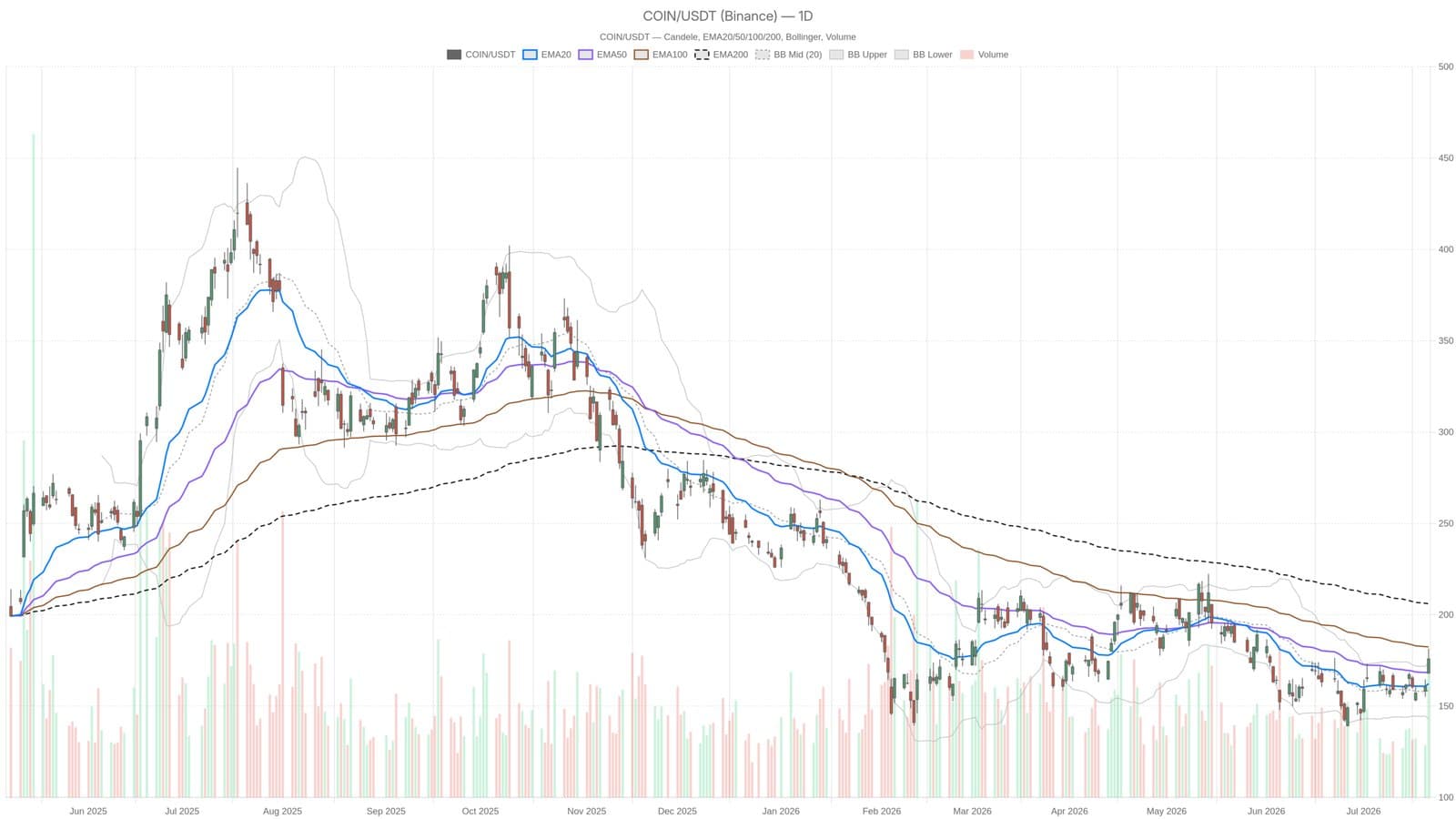
Coinbase stock surged 11% on July 21 following the White House and Senate Republicans' agreement on the CLARITY Act, signaling renewed investor optimism about clearer digital asset regulations. This move highlights the market's sensitivity to legislative developments that could shape the future of crypto exchanges.
Technical Landscape and Momentum
Despite the rally, Coinbase’s shares closed at $175.85, still significantly below the 200-day exponential moving average (EMA200) positioned at $206. This gap shows a persistent longer-term bearish trend that the stock must overcome for a sustained breakout. The daily chart shows that the price has comfortably surpassed shorter-term trend indicators the EMA20 at $162.29 and EMA50 at $168.67 indicating positive momentum building. However, the resistance presented by the EMA200 remains a critical hurdle.
The stock’s volatility is notable, with an average true range (ATR) of $10.16 reflecting large daily price swings becoming commonplace rather than exceptions. This elevated volatility raises both opportunity and risk for traders eyeing short-term gains against potential pullbacks.
Momentum indicators paint a nuanced picture: the daily relative strength index (RSI) stands at 58.71, which suggests constructive momentum without entering overbought territory. Meanwhile, the moving average convergence divergence (MACD) histogram has shifted positive at 1.98, hinting at a subtle but not yet confirmed upward momentum shift.
Implications for Investors
Coinbase’s price action following the CLARITY Act agreement shows how regulatory clarity can act as a catalyst for crypto market movements. Investors should monitor whether the stock can close the gap toward its EMA200 near $206 to confirm a longer-term trend reversal. Until then, the outlook remains cautiously optimistic, with recovery underway but breakout unproven.
The scenario also exemplifies a broader market theme where legislative developments intertwine with technical analysis, influencing trading strategies. For participants focused on regulatory impacts, this development provides a tangible case study of how policy shifts can move major exchange stocks.
This material is informational and does not constitute financial advice.