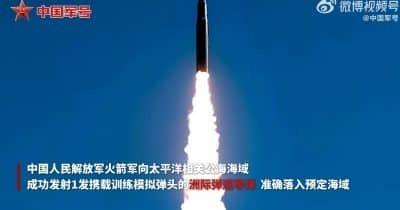
In an alarming development, China is reportedly preparing to test a nuclear-capable long-range missile in the South Pacific within the next 24 hours. According to Australian media, this missile, a variant of the Dong Feng-31AG, will be launched with a dummy warhead as part of the People's Liberation Army Rocket Force's routine annual training exercises.
While China insists that this test complies with international law and is not aimed at any particular nation, it has triggered significant concern among countries in the region. Australia, New Zealand, and various Pacific Island nations are apprehensive due to the missile's launch site being within the South Pacific Nuclear-Free Zone.
Geopolitical Implications of the Test
This forthcoming missile test marks the second full-range intercontinental ballistic missile (ICBM) launch over international waters in the past 44 years, presenting a notable demonstration of China’s technological capabilities. Although the primary goal is to validate delivery accuracy and systems performance, the act serves as a reminder of the extensive reach and military readiness of the Chinese armed forces. Such demonstrations could potentially escalate tensions, raising the risk of miscalculation in a highly volatile regional landscape.
Market Reactions and Predictions
Investor sentiment is likely to be affected by the unfolding situation. Many analysts suggest that this missile test could exacerbate existing tensions, particularly influencing the dynamics between China and Japan. There is increasing speculation about the potential for a military clash between these two nations, with predictions of heightened military readiness becoming more pronounced leading up to 2027.
- Possible increase in military exercises in the region.
- Heightened diplomatic protests from neighboring countries.
- Potential shifts in market pricing related to military tensions in the Taiwan Strait or the Senkaku/Diaoyu Islands.
The geopolitical sensitivity surrounding China's missile testing operations cannot be understated, especially considering the historical critique from adjacent countries regarding transparency. As engagement with regional powers intensifies, any statements from significant figures such as Sanae Takaichi or Lin Jian may further alter the operational landscape.
In summary, while this test is not characterized as an immediate threat, it undeniably highlights the ongoing tension in the region. As the situation unfolds, investors should closely monitor military movements and diplomatic communications to gauge the potential impacts on the overall markets and regional stability.