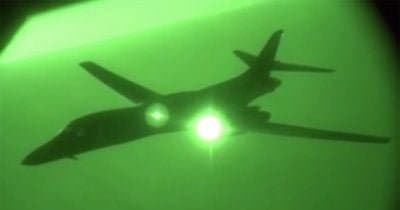
"Market pricing for a full Iranian airspace closure by July 31 has jumped to 36% YES." That single prediction-market signal, reported by @IranIntl_En, may tell you more about where this conflict is heading than any official Pentagon statement. The U.S. military's decision to deploy a B-1 bomber for strikes against Islamic Revolutionary Guard Corps targets inside Iran is not a routine sortie. The B-1 carries one of the heaviest conventional payloads in the American arsenal and was designed specifically to penetrate hardened, fortified sites at long range. Choosing it signals that the target set has moved up the value chain, well beyond the militia outposts in Iraq and Syria that absorbed earlier rounds of U.S. fire in this campaign.
The air campaign itself has been running since early 2026, with American strikes steadily working through Iranian air defenses and missile infrastructure, particularly around the Strait of Hormuz. That chokepoint handles roughly 20% of global oil trade, and every strike in its vicinity sends a tremor through freight and energy markets. The Andimeshk strike earlier this month already pushed airspace closure odds upward; this latest B-1 mission accelerates that trajectory. A 36% probability for full Iranian airspace closure within nine days is not a fringe outcome anymore, it is something airlines, insurers, and Gulf state operators are actively modeling into their contingency plans.
The knock-on effects extend well beyond flight paths. Observers are watching the Civil Aviation Organization of Iran for any formal closure announcement, which would lock in the YES outcome on airspace prediction markets and almost certainly drag crude benchmarks higher within hours. Iranian leadership statements and Gulf state responses will matter too: the probability of Iran taking direct military action against a Gulf neighbor has already shifted in near-term markets following this strike. Red Sea tanker markets have been pricing in exactly this kind of escalation ladder for weeks, and a B-1 strike on IRGC soil is the sort of data point that firms up those bets rather than softens them.
What makes this moment structurally different from earlier exchanges is the combination of platform choice and geography. Previous U.S. retaliatory strikes hit Iranian proxies on Iraqi and Syrian soil, keeping the confrontation one degree removed from Iran proper. Putting a B-1 over Iranian territory collapses that buffer. Iran has limited near-term options that do not carry massive escalation risk of their own, but the 36% airspace closure figure suggests markets are not assuming Tehran stays quiet either. The next 72 hours of signals from Iranian state media and CAOI will be the real scorecard.
This article is for informational purposes only and does not constitute financial or investment advice.