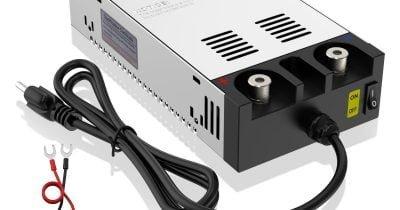
Advanced Energy Industries has officially introduced its new ADH series of DC-DC converters, designed to address a critical power requirement in modern computing. Targeting the 800 V DC power architectures that are becoming prevalent in AI data centers, these converters are capable of stepping down voltage to 50 V DC with an exceptional peak efficiency of 98.2%.
The technological underpinning is significant; converters operate at multi-MHz switching frequencies, indicating their capability to meet rapid power demands without losing efficiency. With a peak power output of 8 kW and a full load capacity of 6 kW, the infrastructure these converters provide aligns with the massive energy needs of high-performance computing tasks, including AI workloads.
At maximum performance, the converters achieve over 2,700 watts per cubic inch, maximizing energy density while minimizing heat loss to just 1.8 watts per 100 watts of electricity. In contrast, traditional AC-based systems incur a far greater loss during conversion steps.
Implications for the Crypto Mining Sector
Interestingly, the implications of this technology extend well beyond AI deployment; crypto miners should note the emerging 800 V DC architecture. This standard, borrowed from electric vehicles and solar power, dramatically simplifies the power distribution process, potentially reshaping energy consumption dynamics in the crypto mining sector.
Major companies, including Vertiv and Navitas Semiconductor, are also entering this 800 V DC space, highlighting that Advanced Energy's launch is likely part of a larger, industry-wide transition. For stakeholders, this alteration in infrastructure could signal a shift towards more efficient and sustainable power usage across the computing landscape, thus influencing long-term operational costs.
For investors, Advanced Energy, traded on NASDAQ under the ticker AEIS, occupies a unique niche that spans both the AI and crypto domains. While traditionally viewed as an infrastructure company, its products are set to play a pivotal role in shaping energy efficiency for emergent technological demands. However, investors should be cautious; infrastructure transitions can be slow, with revenue growth often lagging behind prevailing market narratives.
This article is for informational purposes only and is not financial advice.