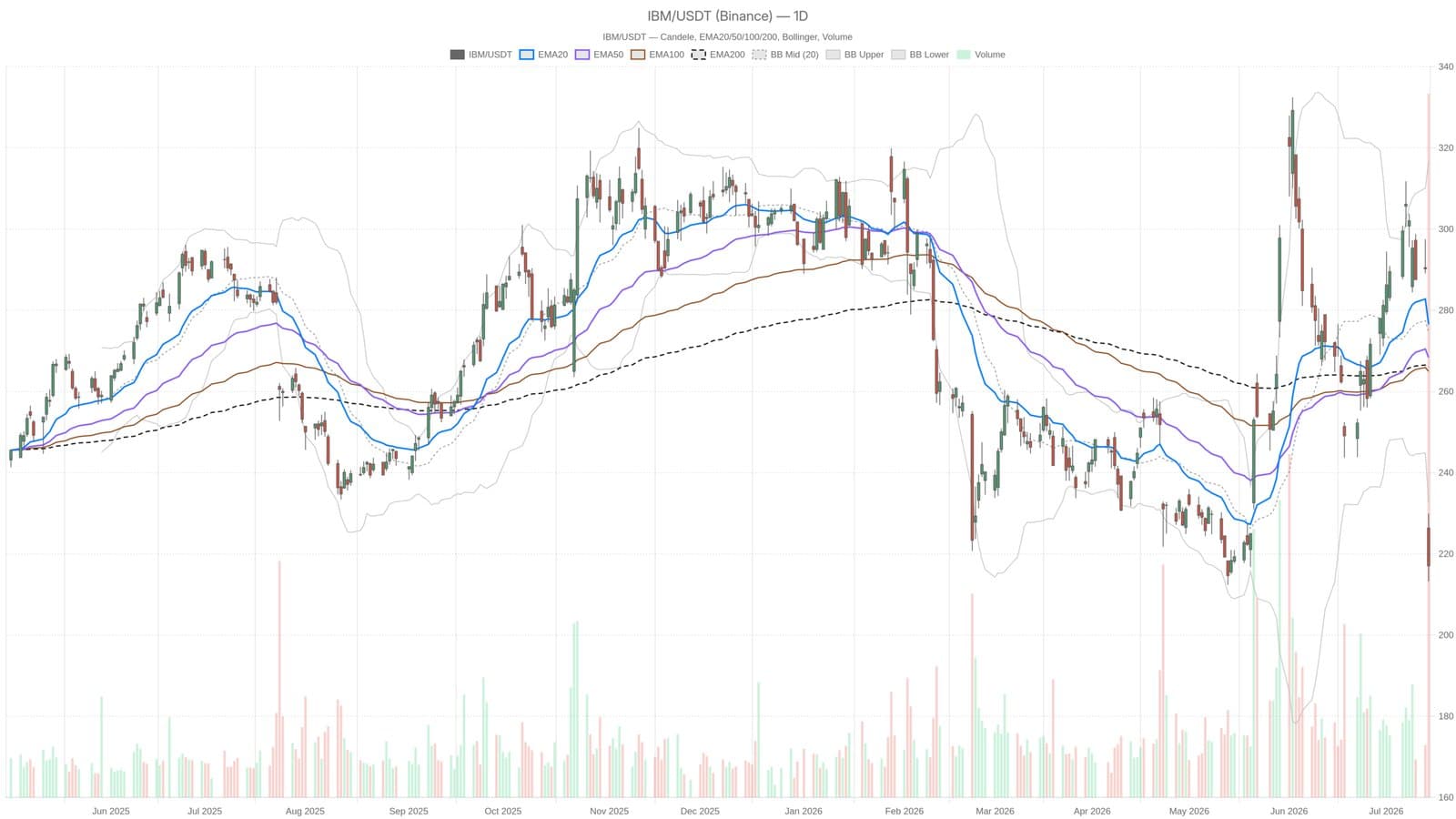
On July 14, 2026, a seismic shift occurred in the stock market as International Business Machines (IBM) witnessed a dramatic 25% drop in its share value. This unprecedented decline was triggered by enterprise customers reallocating their IT budgets away from IBM's core software and infrastructure offerings, a move that has sent shockwaves through the technology sector.
The stock closed at $217.07, significantly lower than its daily EMA20 of $276.52 and EMA50 of $268.37, indicating a deep plunge into oversold territory. The daily relative strength index (RSI) fell to a staggering 30.34, while the hourly RSI plummeted to 14.92, raising alarms about potential further declines.
Market Reaction and Immediate Implications
Investors reacted swiftly to this news, leading to a chaotic trading session where IBM's shares opened at $226.37, peaked at $229.92, and then spiraled down to an intraday low of $213.22. The volatility was extreme, with a daily average true range (ATR) of $16.65, displaying a market that is not just unsettled but in a state of revaluation.
This drastic movement has roots in changing enterprise spending patterns that were echoed in market analyses, suggesting a broader concern regarding the sustainability of IT budgets in a tightening financial environment. The stock's behavior was likened to that of a penny stock, a characterization rarely associated with a blue-chip company like IBM.
Technical Breakdowns and Future Outlook
Technically, IBM's stock has entered a troubling phase, with significant indicators painting a bearish picture. The shares' closing price is well below critical moving averages specifically, the EMA20, EMA50, and EMA200, which stand at $276.52, $268.37, and $266.03, respectively. This suggests that IBM is not merely facing a short-term setback but is in a structural breakdown.
Support at $210.22 (daily S1) is now crucial, while resistance levels at $220.07 (daily pivot) and $226.92 (daily R1) will be closely watched. The trading patterns indicate that the stock may remain under pressure unless a substantial shift occurs in customer confidence and spending.
Given the current climate of uncertainty, particularly in the AI landscape, as previously discussed in our article How IBM's 25% Plunge Signals Trouble for AI Software Spending, the implications of IBM's stock slide extend well beyond company performance. It serves as a bellwether for the larger technology spending environment, suggesting that companies might be reconsidering their digital transformation investments amid economic pressures.
This article is for informational purposes only and is not financial advice.