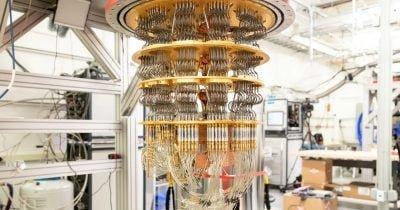
Google has made significant strides in quantum computing with the introduction of a reinforcement learning system capable of real-time calibration of quantum processors. This development promises to enhance error stability by 3.5 times, marking a potential turning point for the industry and bringing to light the implications for cryptographic security.
Technical Breakthrough: Real-Time Calibration
The essence of Google's innovation lies in its ability to maintain stable quantum operations without halting computations for recalibration. Historically, quantum computing has faced challenges due to the instability of superconducting qubits, which often behave unpredictably and require frequent adjustment. With the new calibration system, the Willow processor can dynamically tune its parameters in real time based on error-detection signals. This achievement not only improves the logical error rate stability significantly but also reduces the overall logical error rate by approximately 20% compared to traditional methods.
Implications for Cryptography
For the cryptocurrency world, Google's advancements are far from merely academic. As quantum computing technologies develop, the looming threat to traditional encryption methods such as elliptic-curve and RSA becomes more tangible. While current quantum machines lack the power to execute Shor's algorithm against production-grade encryption, progress in quantum capabilities could shift the balance dramatically. The National Institute of Standards and Technology (NIST) has already established post-quantum cryptographic standards, suggesting that a proactive approach is crucial in safeguarding digital assets.
Numerous blockchain projects, including discussions among Ethereum researchers regarding post-quantum signature schemes, indicate that the crypto community is beginning to confront the reality of quantum threats. The question remains: how quickly can existing technologies adapt, and what migration paths will be viable for blockchain networks as the quantum landscape evolves?
The Competitive Landscape
It's important to note that Google is not alone in this race. Companies such as Q-CTRL and NVIDIA are collaborating on AI-driven quantum control, while others like Rigetti and Quantum Machines are also developing automated calibration solutions. The competitive atmosphere around quantum development will likely expedite advancements, leading to an accelerated timeline for potential vulnerabilities in cryptographic practices. As the stakes rise, the crypto sector must remain vigilant and prepared for disruptive changes.
This material is informational and should not be considered financial advice.