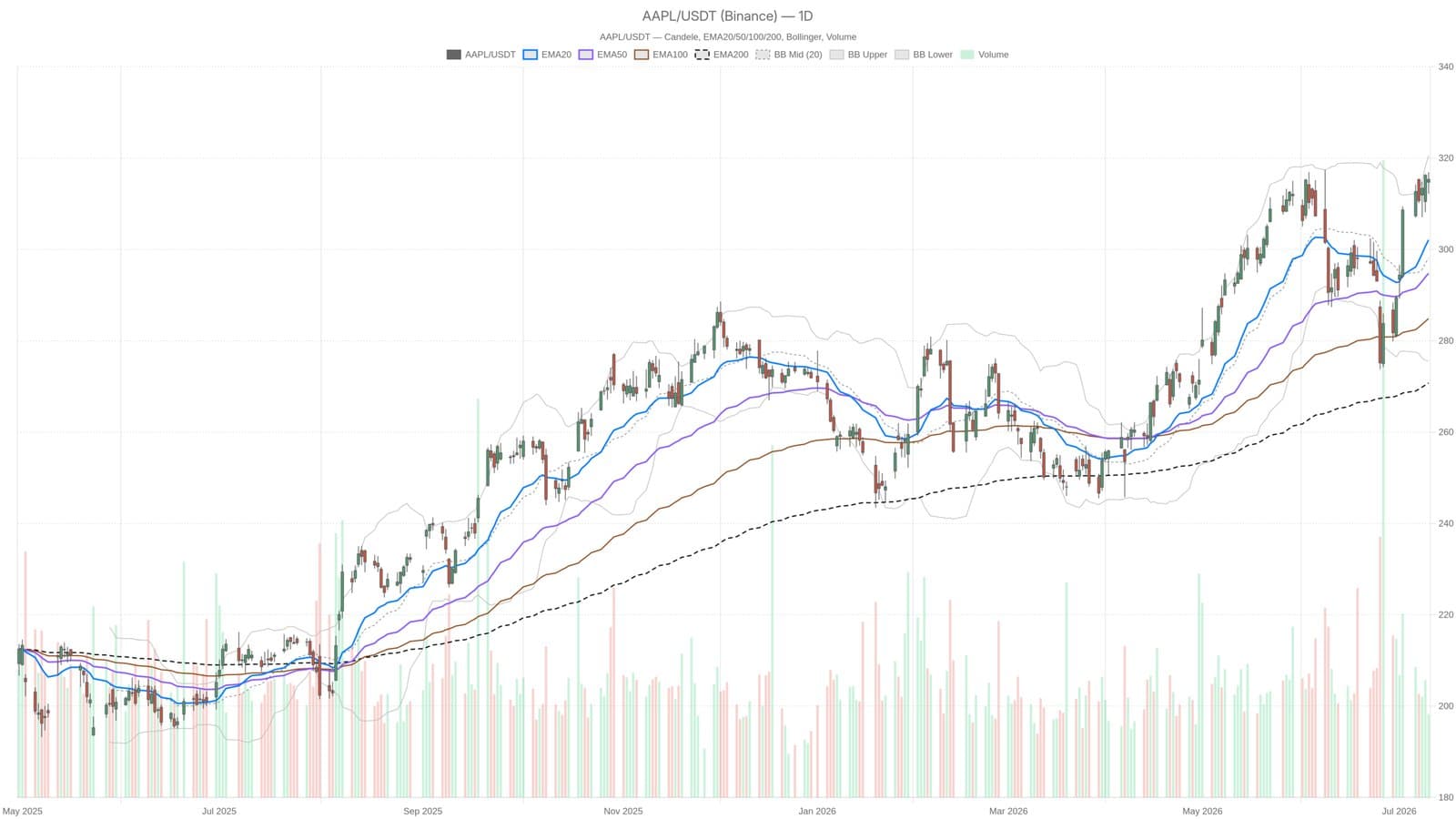
As of July 10, Apple Inc. (AAPL) stock has closed at $315.32, marking a substantial 48.9% increase over the past year. This impressive rally signals a strong bullish sentiment, yet the stock is now approaching a critical resistance level at $320.61, marked by the upper Bollinger Band. Here, the question arises: should investors exercise caution as the stock nears this ceiling?
Current Market Dynamics and Indicators
The current trading environment for AAPL suggests sustained institutional interest, as indicated by its position above key exponential moving averages (EMAs). Specifically, the stock trades significantly above the EMA20 at $302.08, EMA50 at $294.78, and EMA200 at $270.76. This upward alignment of EMAs typically reflects a healthy buying momentum.
Moreover, the daily Relative Strength Index (RSI) is at 62.93, suggesting that while there is still room for further gains, the stock is nearing overbought territory. Each increase in price confirms the bullish outlook, particularly as long as the RSI remains above 55. Should it drop below this threshold, a shift in market sentiment could occur.
Looking Ahead: Potential Risks and Catalysts
Despite the positive momentum, investors should remain vigilant about potential risks. For example, the recent $30 billion deal with Broadcom could act as a strong fundamental catalyst, but uncertainties surrounding AI monetization could introduce volatility. Such factors could shape the market's perception of AAPL and influence future price movements.
Furthermore, the daily Average True Range (ATR) of $8.95 indicates significant intraday price fluctuations. This volatility means any potential price reversals could be sharp and rapid. The current pivot level stands at $314.80, with resistance at $317.43 and support at $312.69. A break above resistance could signal continued bullish action, while a close below support might suggest a cooling off of buying interest.
In summary, while AAPL's near-term indicators favor bullish momentum, the stock's proximity to resistance raises questions about sustainability. Investors must weigh the potential for continued gains against the backdrop of market volatility and fundamental uncertainties.
This material is informational and should not be considered financial advice.