Uber is spending $10 billion on autonomous vehicles. That's a seismic shift for a company built on getting other people to use their own cars. The move marks the end of the ride-hailing giant's famous asset-light playbook.
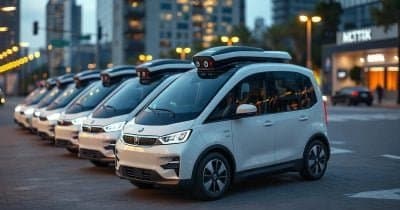
The capital split is roughly straightforward: $7.5 billion toward actual fleet purchases, another $2.5 billion into equity stakes in AV developers and manufacturers. The target is at least 15 cities with robotaxi services by year-end 2026, expanding to 28 cities by 2028. Atlanta, Austin, Las Vegas, and Dallas already have recent rollouts, all picked for relatively loose regulatory environments.
The hybrid bet
Uber isn't going pure robotaxi. Instead, the company is betting on a mixed fleet where riders get either a self-driving car or a human driver depending on what's available, how complex the route is, and which city they're in. It's a deliberate hedge. If a robot can't handle a particular road or weather condition, a human driver steps in through the same app.
The partnership lineup matters. Uber put $300 million each into Lucid and Rivian, positioning both EV makers as fleet suppliers. The bigger partnership is with Nvidia, though. The two companies are collaborating on 100,000 autonomous vehicles expected to roll out starting in 2027.
Uber set up its Autonomous Solutions unit in February 2026 specifically to support AV partners with data, mapping, and commercialization work. The company has been vocal about criticizing pure-AV approaches from competitors like Waymo, arguing its hybrid model is far more practical when technology hits real-world friction.
This material is informational only and should not be considered investment advice or a recommendation to buy or sell any security.