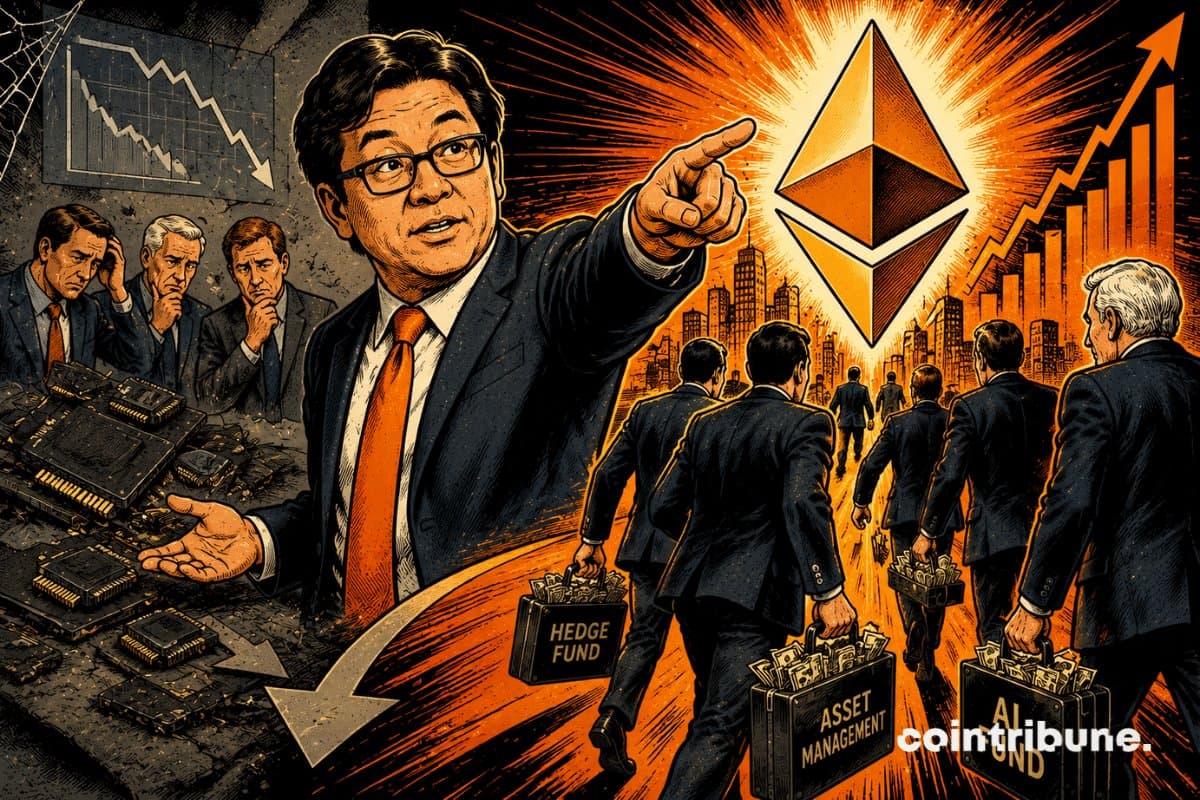
A 7,200 basis point gap opened up between Ethereum and the Roundhill Memory ETF over a single month, and Fundstrat's head of research Tom Lee is treating it as a signal rather than coincidence. ETH gained 24% during that stretch. DRAM, the fund launched on April 2, 2026, as the first ETF dedicated entirely to memory chip manufacturers, fell 38% in the same window.
Lee posted on X that "the AI downstream trade continues to strengthen," pointing to that spread as evidence that capital once orbiting the AI hardware boom is drifting further down the value chain toward Ethereum. His argument is straightforward: if money is leaving memory chip proxies and Ether is outperforming, the natural read is a rotation, not a coincidence.
What the "AI downstream trade" actually means here
The idea Lee is selling is that AI investment cycles move in waves. First comes infrastructure, servers, GPUs, high-bandwidth memory. Then, once that buildout matures or gets crowded, capital looks for the next layer down the stack, the networks, platforms, and protocols that run on top. Ethereum, with its programmable settlement layer and growing institutional profile, fits that narrative neatly.
The limitation Lee himself doesn't address is that he's reading a performance gap, not actual fund flows. He shows ETH going up and DRAM going down. He does not show money leaving memory stocks and landing in ETH wallets or ETH spot funds. Those are two different claims, and only one of them is supported by the data he presents.
The DRAM ETF decline tells a messier story
DRAM covers manufacturers across DRAM, NAND, and high-bandwidth memory, the HBM segment that's been central to AI chip demand. Yet the fund's poor month sits awkwardly next to the broader data. TrendForce, as of July 3, was forecasting contractual DRAM prices to rise 13% to 18% in Q3 2026, with NAND Flash expected up 10% to 15%. IDC still projects $758 billion in global AI-related spending by 2029.
A fund can underperform even when its underlying industry is healthy. Profit-taking after a sharp run, sector rebalancing, or a simple mean reversion after overextended positioning can all produce a 38% drawdown without signaling any fundamental retreat from AI hardware. The decline in DRAM does not confirm an exodus from the theme.
What Lee has identified is a divergence in stock market behavior between two assets. That divergence may yet prove to be the early signal he thinks it is. For now, though, the thesis rests on correlation, not confirmed capital movement. Ethereum does benefit from the AI narrative landing on it, because narrative alone moves prices in crypto markets. The $758 billion AI spending forecast and the memory price upticks suggest the hardware trade isn't dead, just temporarily out of favor with momentum traders.
This article is for informational purposes only and does not constitute financial advice or an investment recommendation.