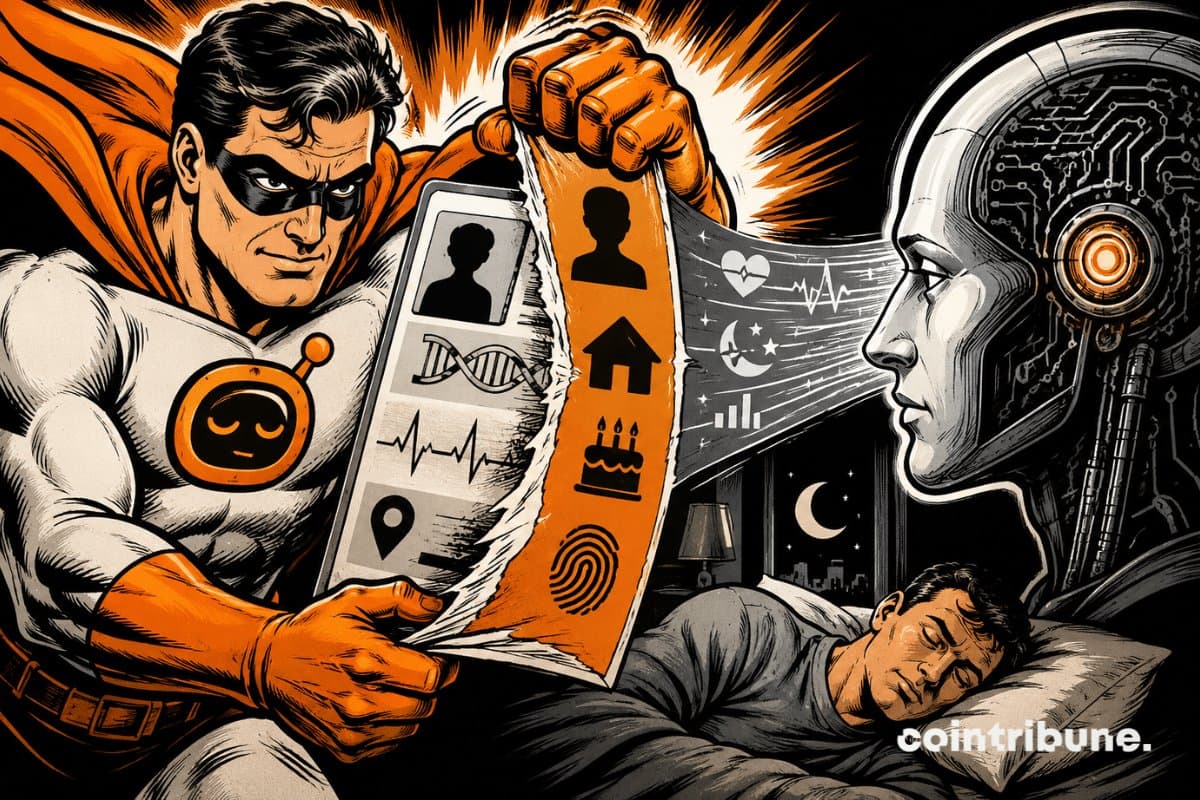
Sleepagotchi has quietly killed its original business idea. The Web3 sleep-tracking app once planned a marketplace where users could sell their biometric data to researchers. That model is gone, replaced by something far more technical and, arguably, more defensible.
The project, which claims $6.5 million raised from backers including 6th Man Ventures, Collab+Currency, 1kx, Sfermion, GSR and Signum Capital, has rebuilt its core argument around a single pipeline: no identifiable health data ever lands on its servers. Statistics leave your device in anonymized form, get processed server-side, and the anonymized input is discarded once the response comes back. Nothing is retained.
Why "anonymous in, nothing kept" is a different claim than "local AI"
Most on-device AI pitches in the wellness space promise that your data never leaves your phone. Sleepagotchi doesn't go that far, and that's actually the point. Running a capable language model on consumer hardware would gut what the AI can realistically do. Instead, the company routes anonymized statistics to a server, processes them, returns the result, then drops the input. That narrower promise, anonymous data plus non-storage, is what the team points to for GDPR compliance and equivalent frameworks in other regions.
It also explains why CEO Kenny Wood, appointed in May 2026, framed the pivot away from data resale in practical terms: commercial sale of health data collides with regulation, but it also runs into the terms of service of the wearable manufacturers whose devices generate that data in the first place.
Four AI agents, one recommendation chain
On top of that pipeline sits a chain of four specialized agents that hand off to each other rather than working in isolation:
- A Sleep Coach analyzes rest cycles and identifies patterns.
- A Wellness Assistant picks up those findings and, if it spots lingering fatigue despite adequate sleep, looks for nutritional gaps, flagging something like low iron intake.
- A Meal Planner converts the recommendation into a concrete ingredient list.
- A Shopping Agent closes the loop by placing the order within a budget the user sets.
The app already has a track record of sorts. The Telegram Lite version counts 2 million all-time users, and company documentation puts revenue at over $100,000 across a three-week beta period. Those numbers are self-reported, but they suggest at least some real-world traction in a sector that has spent the better part of a decade collecting health data first and worrying about the consequences later.
This article is for informational purposes only and does not constitute financial or investment advice.