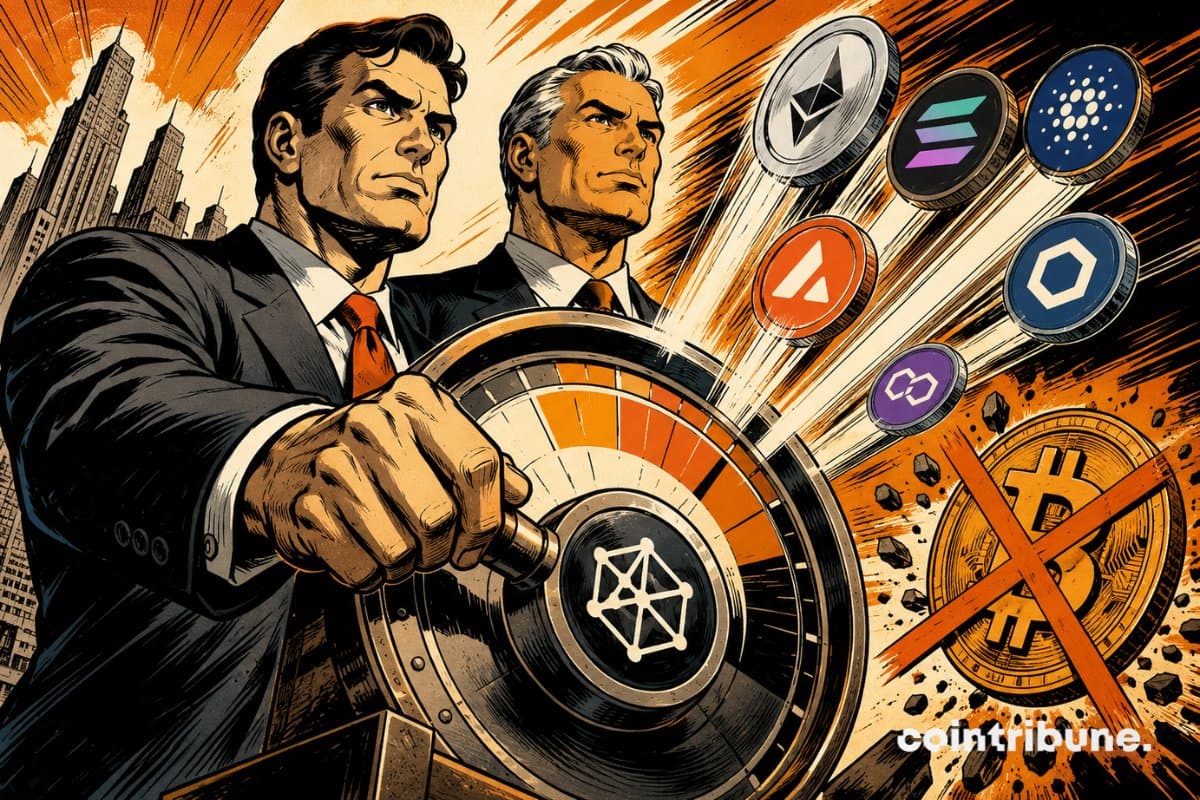
Eighteen tokens, a $500 million market cap floor, and zero bitcoin. That is the opening lineup of the S&P Pantera Digital Asset Index, a joint venture between S&P Dow Jones Indices and Pantera Capital targeting institutional money looking for structured exposure to the blockchain economy.
Revenue over reputation
The methodology flips the usual script for crypto benchmarks. Instead of ranking assets by price momentum or name recognition, the index selects protocols based on revenues generated over the previous two quarters. Smart contract platforms and decentralized finance protocols sit at the core of the selection universe, evaluated the way a traditional equity analyst would assess a company: by what it actually earns from economic activity on its network.
Each candidate must clear a $500 million minimum market capitalization. Once admitted, no single asset can exceed 35% of the total weight, a cap designed to prevent the kind of bitcoin-or-bust concentration seen in most existing crypto indices. The index rebalances every quarter, which keeps the composition tied to current fundamentals rather than historical hype cycles.
The launch basket includes Ether, Solana, BNB, Tron, and Hyperliquid, among others. Memecoins and projects with thin on-chain activity did not make the cut. The practical result is a portfolio that looks far closer to a sector ETF than to a speculative token basket.
Why bitcoin got excluded
Bitcoin's absence is the sharpest editorial decision in the whole design. The two firms concluded that bitcoin does not function as a revenue-generating protocol in the way smart contract networks do. It does not collect fees from decentralized applications, it does not host a DeFi ecosystem, and its economic model is built around monetary scarcity rather than protocol utility. By the index's own criteria, that disqualifies it, regardless of bitcoin's dominant market share.
That exclusion is a direct break from the major benchmarks in the space. Most broad crypto indices allocate 40% to 60% of their weight to bitcoin by default. Stripping it out entirely reshapes the risk profile completely and signals that the two firms are betting institutional demand will shift toward networks where revenue metrics actually mean something.
What this means for institutional products
S&P's brand carries weight in the index licensing business. Funds, ETFs, and structured notes routinely track S&P benchmarks, and the firm's involvement suggests the index is built to serve as the underlying for future financial products rather than as a research exercise. Pantera, one of the oldest dedicated crypto investment firms, brings the sector expertise needed to keep the methodology credible with crypto-native scrutiny.
For institutional allocators, the appeal is straightforward: a rules-based, quarterly-rebalanced benchmark that speaks the language of fundamental analysis rather than token speculation. Whether fund managers will actually build products around it depends on how the 18-token basket performs against simpler bitcoin-heavy alternatives over the next few quarters.
This article is for informational purposes only and does not constitute financial or investment advice.