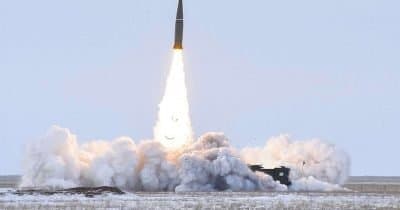
Video footage circulating on social media captured a Russian Iskander missile hitting Kyiv with cluster munitions aboard, setting off a rapid-fire chain of explosions across the city. The strike fits the pattern of relentless bombardment that has defined the war for years now, but the choice of payload matters. Cluster munitions scatter submunitions over a wide area, which means less precision, more indiscriminate damage, and civilians caught in the fallout.
The Iskander is a short-range ballistic system that Russia has refined specifically to punch through electronic defenses. This particular variant can carry different warhead types, and when fitted with cluster munitions, it turns into a wide-area weapon that trades accuracy for coverage. Each detonation filmed in the footage suggests multiple submunitions going off in sequence, the kind of cascade that makes it nearly impossible for air defense systems to intercept everything.
The incident signals something traders are already pricing in. Prediction markets currently put the odds of a direct NATO-Russia military clash by year-end 2026 at around 25 percent. That's not trivial. Every escalation in the conflict, especially when it involves newer weaponry or strikes in high-profile targets like the capital, nudges those probabilities. NATO officials and Western governments will be watching for what comes next. A formal response could range from diplomatic statements to increased military aid to Ukraine, each move carrying weight in how markets perceive the trajectory.
What observers are really tracking is whether this represents a genuine shift in Russian tactics or just continuation of the same grinding assault. The use of cluster munitions in an urban setting suggests Moscow sees value in saturation strikes over precision targeting, which could indicate either desperation or confidence that air defenses are degraded enough to make the gamble worthwhile.
This article is informational only and does not constitute financial or investment advice. Geopolitical risk assessments are inherently uncertain.