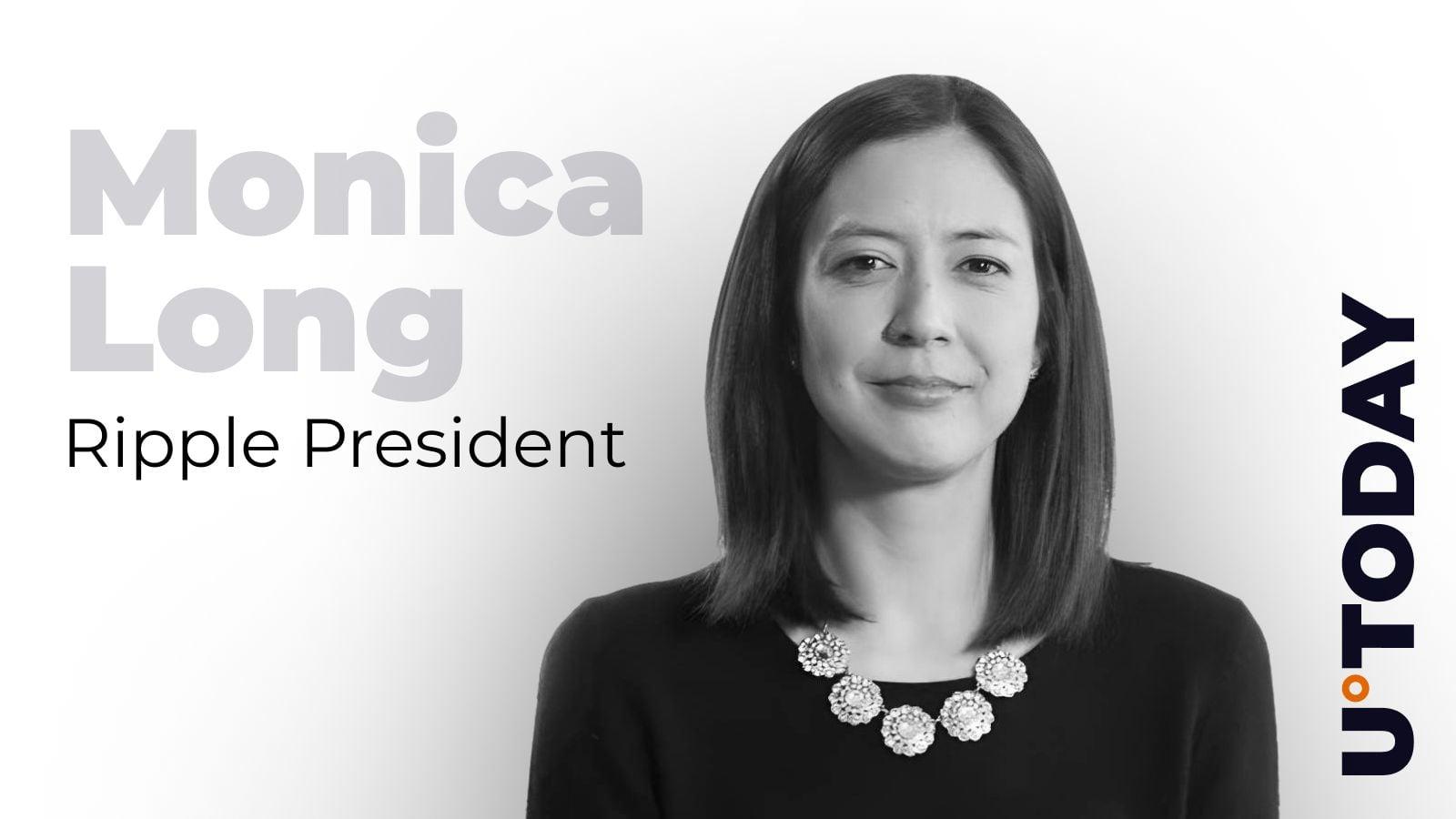
Ripple's Monica Long Outlines the Road Ahead for XRP, XRPL, and RLUSD in Institutional Payments
Ripple President Monica Long has shared her vision for the future of digital payments, emphasizing a multichain strategy built around the XRP Ledger, XRP, and RLUSD for institutional finance. Her comments followed Ripple's joining of the Open USD stablecoin consortium as a day-one integration partner.
Ripple President Monica Long has laid out a bold roadmap for the company's role in the evolving global payments landscape, placing the XRP Ledger, XRP, and RLUSD at the center of its institutional strategy.
In a statement shared on June 30, 2026, Long articulated her vision clearly: "The future of payments will be multichain, interoperable, and built on institutional-grade blockchain infrastructure." Her comments came in response to a wave of recent industry developments that signal accelerating momentum toward blockchain-based financial infrastructure.
One of the key catalysts for Long's statement was Ripple's decision to join Open USD as a day-one integration partner. Open USD is a dollar-pegged stablecoin initiative launched by a consortium of more than 140 financial and technology companies. The list of founding partners reads like a who's who of both Wall Street and Silicon Valley — Visa, Mastercard, Stripe, Coinbase, BlackRock, BNY, Standard Chartered, Google, and Shopify are all involved. Ripple's participation underscores its commitment to open, multichain infrastructure designed to support institutional adoption across the broader digital asset ecosystem.
At the heart of Ripple's strategy is a straightforward but ambitious goal: to establish the XRP Ledger as the premier blockchain for institutional payments. According to Long, Ripple is actively positioning the XRP Ledger as a settlement infrastructure layer for financial institutions seeking reliable, regulated blockchain solutions. Beyond settlement, the company is also working to make the XRP Ledger a go-to platform for the next generation of regulated stablecoins, while simultaneously expanding the real-world utility and global adoption of both RLUSD and XRP.
The scope of Ripple's institutional operations is already significant. Ripple Prime, the company's prime brokerage and clearing division, processes more than $3 trillion annually on behalf of over 300 institutional clients. Ripple Prime CEO Mike Higgins has indicated that the next phase of development will focus on bringing the prime brokerage and clearing layer directly onto the XRP Ledger itself — a move that could dramatically deepen the ledger's role in institutional finance.
These announcements arrive at a time when financial institutions worldwide are showing growing interest in blockchain-based settlement and regulated stablecoins. Ripple's participation in major industry consortiums, combined with the expansion of native financial products on the XRP Ledger — including recently confirmed native loans and yield products — paints a picture of a company aggressively scaling its infrastructure to meet institutional demand.
With multichain interoperability increasingly seen as a prerequisite for mainstream adoption, Ripple appears to be betting that the XRP Ledger's technical capabilities and regulatory alignment will make it an indispensable piece of the future financial system. Monica Long's vision ties together the company's product suite — XRP as a bridge asset, RLUSD as a regulated stablecoin, and the XRP Ledger as foundational infrastructure — into a cohesive institutional-grade offering for the years ahead.