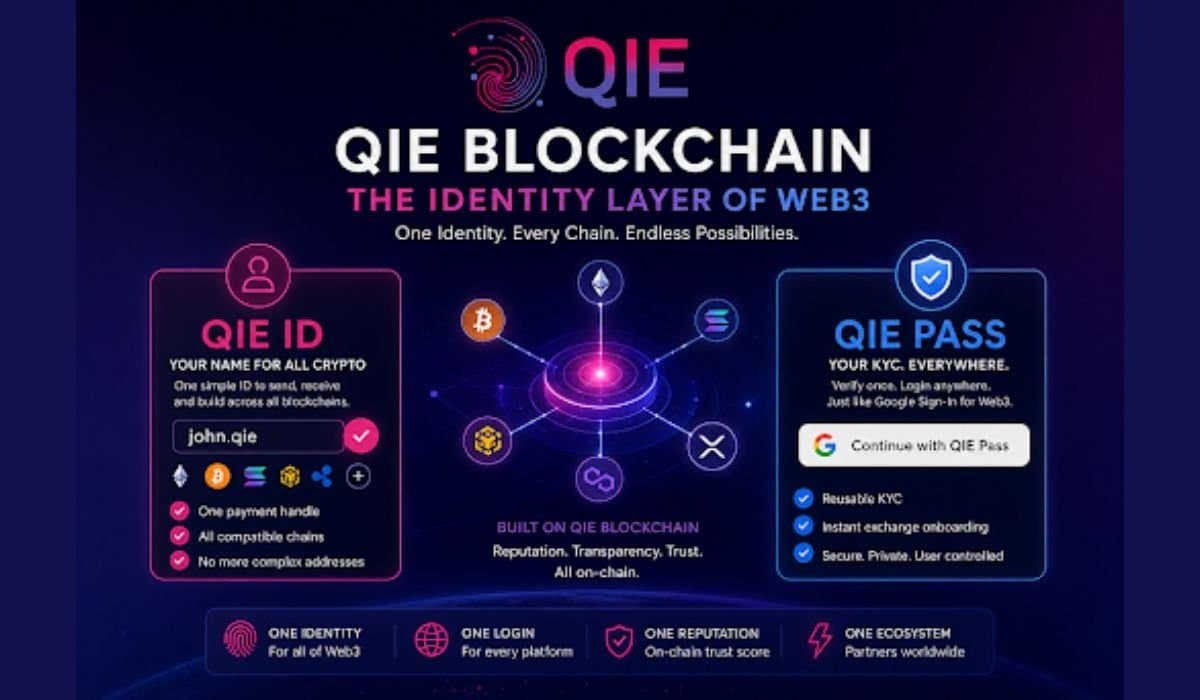
"Sending crypto right now is like emailing someone by typing their server's IP address," one early QIE tester put it. The analogy cuts deep, because it's accurate. Every blockchain wallet is a wall of random characters, every exchange runs its own KYC, and every dApp demands yet another connection. QIE Blockchain is building what it calls the Identity Layer for the global blockchain industry, a single readable handle that sits on top of all of it.
The core product is QIE ID, a custom payment handle in the format yourname.qie. Instead of juggling an Ethereum address starting with 0x, a Bitcoin address starting with bc1q, and a Solana string that looks like a keyboard accident, anyone can receive funds from any of those chains at one address. A free tier hands out a randomly generated ID like xyr34567.qie, which already supports EVM-compatible chains. For a one-time fee starting at $5, users unlock a chosen name that routes payments across Bitcoin, Ethereum, Solana, XRP, and additional chains as they get added. Premium names, things like bitcoin.qie or london.qie, start at $15 and can run to around $100 for high-demand picks. Crucially, there are no annual renewal fees. You pay once, you own it permanently, which puts QIE at odds with most Web3 domain providers that charge yearly.
The second piece is QIE Pass, and the project is careful to separate it from QIE ID. QIE ID answers the question of where to send money. QIE Pass answers who you actually are. The analogy the team reaches for is Google Sign-In: instead of filling out KYC forms from scratch on every platform, a verified QIE Pass holder clicks once to share their existing verification. The KYC process itself runs through Sumsub, a well-established identity verification partner, and users must hold a QIE ID before they can complete it. The practical upshot is that a user who has gone through verification once could, in theory, skip the process on every compliant exchange or dApp that integrates QIE Pass afterward.
Bitcoin solved trustless value transfer. Ethereum added programmable contracts. What neither addressed is the identity gap that still makes crypto feel like routing packets rather than sending money. QIE is not pitching itself as another general-purpose Layer-1 chasing throughput records. The bet is narrower and, arguably, more useful for everyday adoption: make the person on the other side of a transaction legible before you hit send.
This article is sponsored content and does not constitute financial or investment advice. Always do your own research before engaging with any blockchain project.