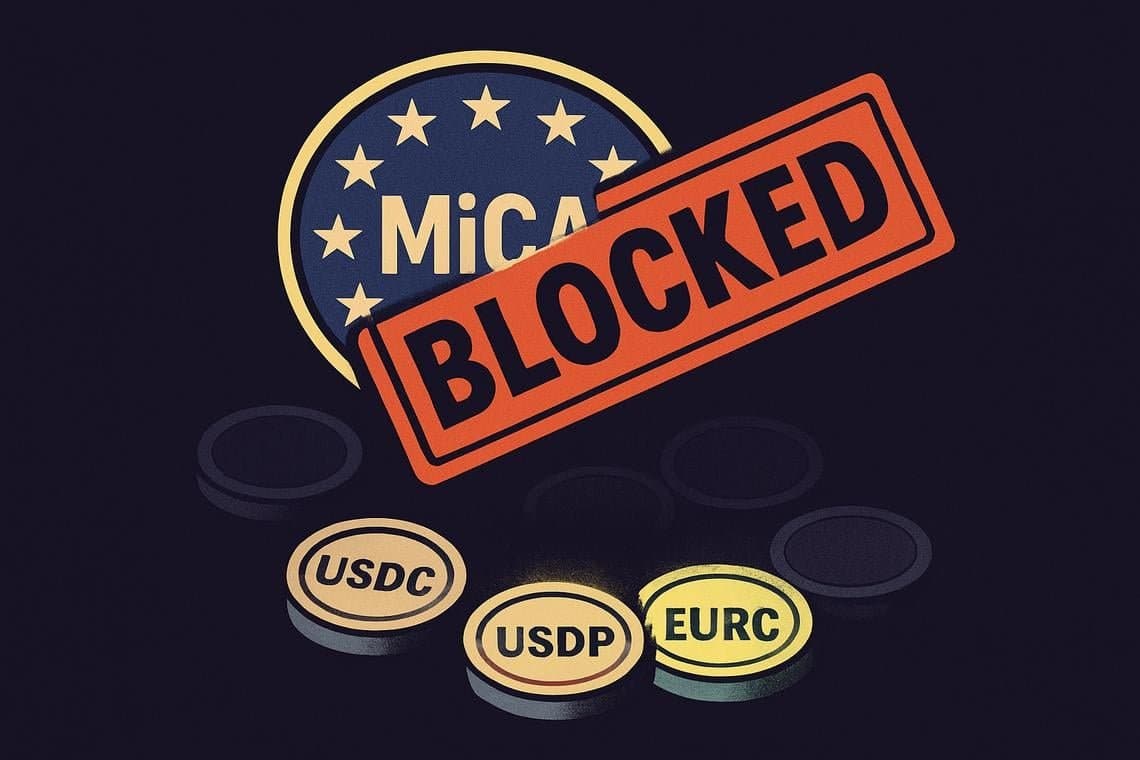
The European Union’s ambitious regulatory framework for stablecoins, MiCA, has so far produced only three compliant tokens among the world’s top 50 stablecoins by market capitalization. All three USDC, USDG, and EURC are connected to Circle, the US-based stablecoin issuer well ahead in securing European regulatory approvals.
While MiCA aims to bring order to the EU stablecoin market, the limited number of compliant tokens reveals a significant gap between global market activity and EU regulatory reach. Patrick Hansen, Circle’s Senior Director of EU Strategy and Policy, confirmed the EU has about 35 regulated e-money tokens issued by 21 entities under MiCA, indicating a growing but still narrow licensing base.
MiCA’s Regulatory Impact and the Compliance Divide
Despite MiCA's structured approach, most of the leading global stablecoins remain outside its perimeter. Only USDC, USDG, and EURC currently qualify as regulated e-money tokens under MiCA, highlighting a sharp divide where the majority of stablecoin market capitalization operates beyond EU rules. This is not just a minor discrepancy; it reflects systemic challenges in integrating global stablecoins within Europe’s regulatory framework.
Circle’s proactive engagement with MiCA contrasts with other issuers who have yet to meet these standards, suggesting that the EU’s compliance demands could be a barrier for broader adoption. The upcoming MiCA review is expected to address these issues, focusing on improving competitiveness, enhancing coordination with global regulators, and creating recognition mechanisms for foreign-regulated stablecoins.
This regulatory landscape contrasts with some market tensions seen elsewhere, such as the US freezing Iranian crypto assets amid geopolitical conflicts, illustrating how regional policies shape the broader crypto ecosystem.
This material is for informational purposes and does not constitute financial advice.