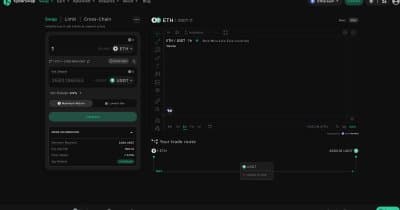
DeFi aggregators have seen a significant shift this year, with KyberSwap capturing 31% of market share amid a 40% drop in overall trading volumes. This movement comes as platforms move away from fixed on-chain routing toward a more flexible, intent-based model.
How Intent-Based Trading Changes the Game
Traditional aggregators break down trades into predetermined on-chain routes across liquidity pools, executing every step in sequence. Intent-based trading flips this by letting users declare their desired outcomes off-chain, such as swapping a certain amount of ETH for USDC with MEV protection. A network of competing solvers then races to fulfill the intent most efficiently. This competition results in better prices and gasless transactions for users, as solvers front gas fees and integrate costs into the trade. also the approach inherently protects orders from front-running by keeping them out of public mempools.
KyberSwap’s Expanding Edge Despite Market Contraction
KyberSwap’s rise is notable against the backdrop of shrinking aggregator volumes and a sluggish crypto market. While volumes have contracted roughly 40% in early 2026, KyberSwap’s extensive infrastructure drawing liquidity from over 420 sources across 17 chains gives it a unique advantage in routing trades optimally. It has processed upwards of $150 billion in transactions so far, outpacing competitors like CoW Swap, which holds about 22%, and 1inch at 15%. CoW Swap, an early adopter of intent-based models, still trails despite pioneering the batch auction mechanism that influenced this evolution.