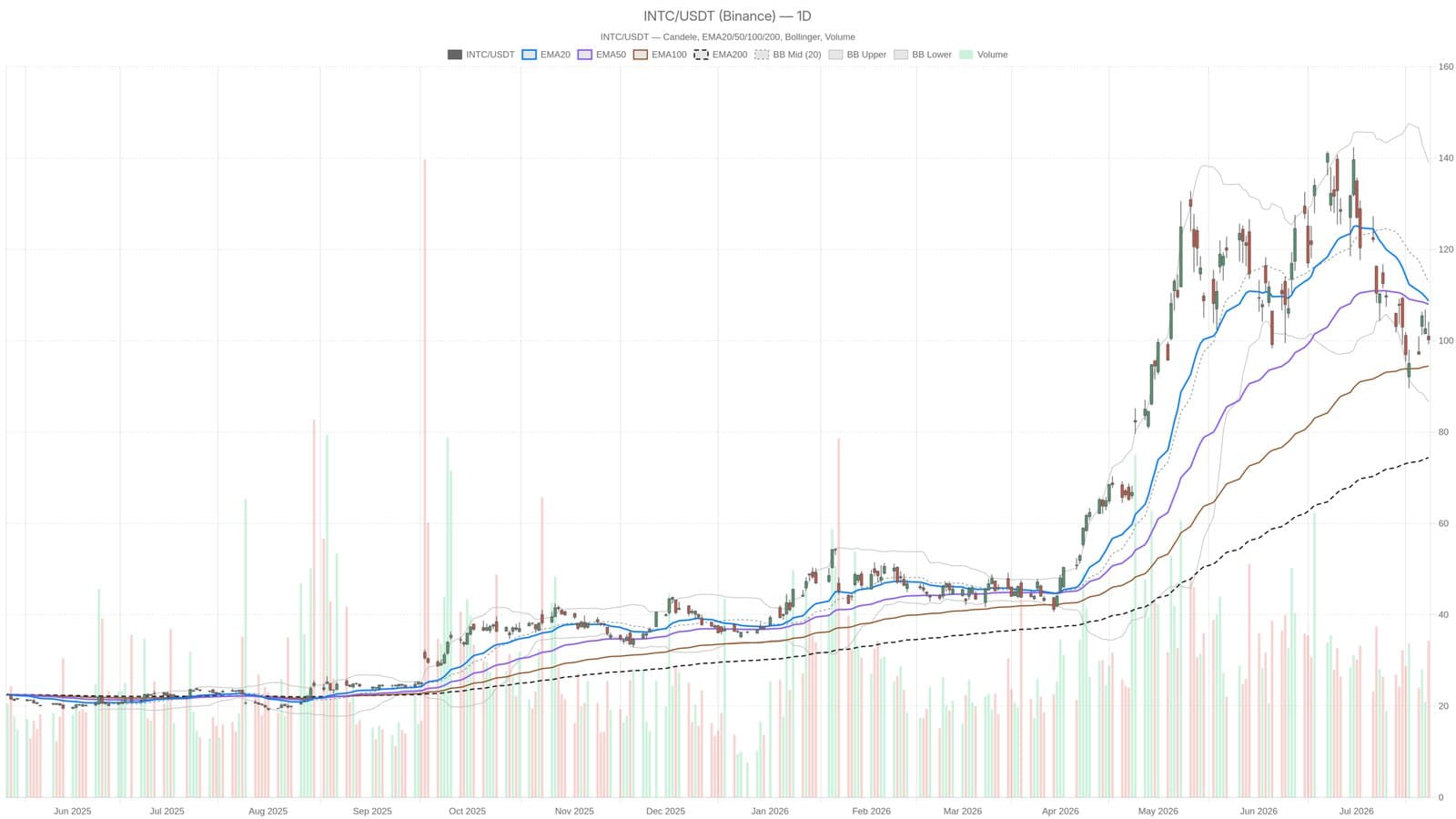
Intel reported a striking 25.4% increase in year-over-year revenue for Q2 2026, hitting $16.13 billion and outperforming Wall Street forecasts. Despite this solid fundamental performance, the stock ended trading on July 23 at $100.23, notably dipping below key technical levels: the daily 20-day and 50-day exponential moving averages, sitting at $108.74 and $107.97 respectively.
Solid Earnings but Technical Risks Persist
The company’s forward outlook added another layer to optimism, projecting $16.3 billion in revenue at midpoint guidance, about 7.8% above analyst expectations. This rebound was fueled by advancements in artificial intelligence and strategic partnerships, which also positively impacted related chip manufacturing equipment providers such as ASML and Applied Materials. Market confidence appears reinforced by Intel’s increased capital expenditure, signaling a long-term commitment to innovation and growth.
However, the price action paints a different picture. Intel's stock rests significantly below the average trading bands and momentum indicators hint at selling pressure. The stock trades in the lower half of its Bollinger Bands, which currently span from $86.61 to $112.82, a sign of distribution rather than accumulation. With the Relative Strength Index (RSI) at 41.89, the stock isn’t yet oversold, offering no immediate signal for a price rebound.
Market Sentiment Mixed as Volatility Rises
Volatility remains elevated, with the Average True Range (ATR) at $7.47, suggesting that investors could see sharp two-way swings in Intel shares following the earnings report. The Moving Average Convergence Divergence (MACD) also remains bearish, reinforcing caution among traders despite the fundamental strength.
Intel's struggle to close the gap with its moving averages reflects technical resistance that bulls need to overcome to maintain momentum. The stock’s current positioning hints that while growth momentum is powerful, overcoming technical hurdles will be critical for sustaining the rally.
This content is for informational purposes and does not constitute financial advice.