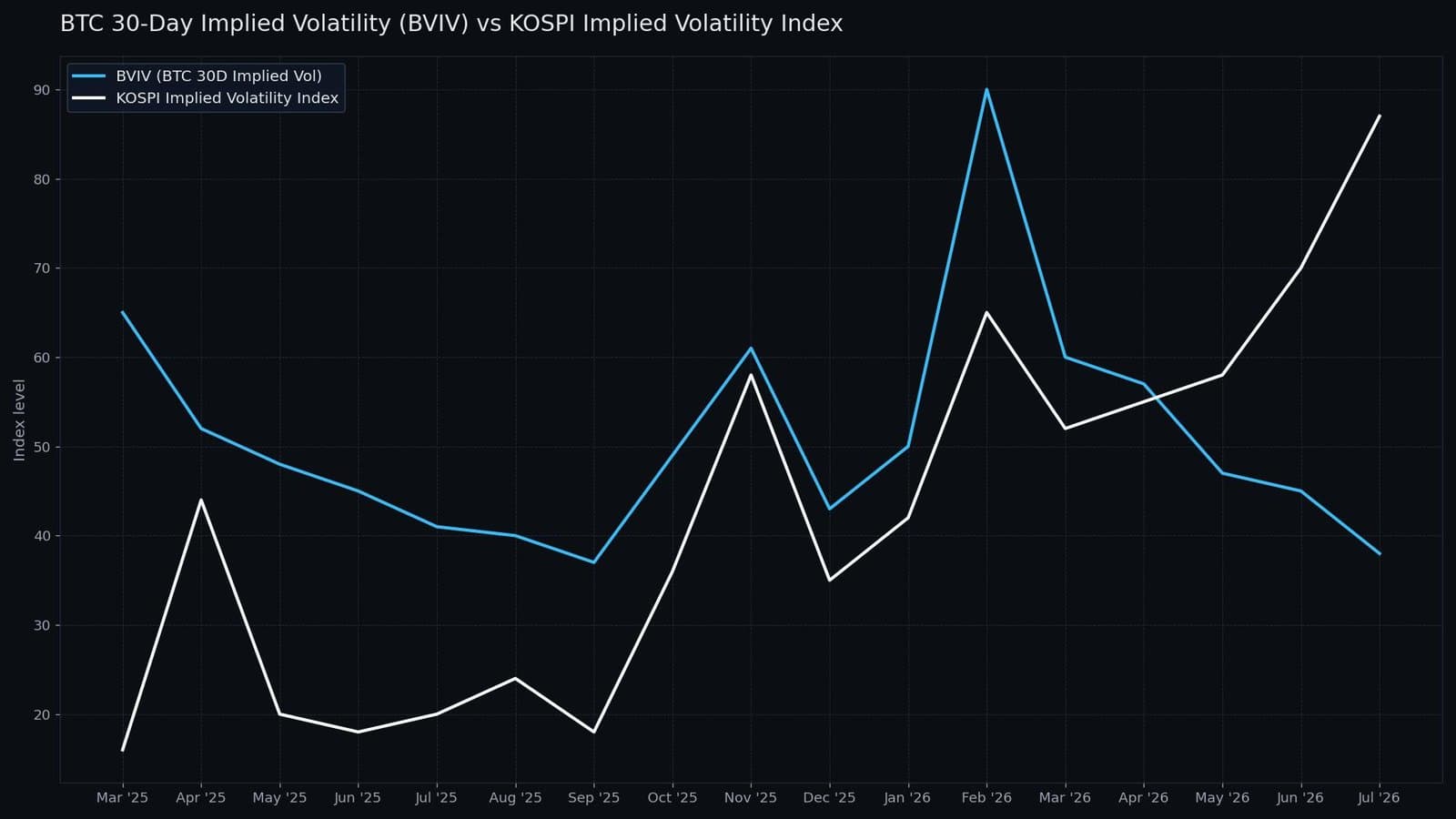
Recent data suggests a significant shift in the volatility dynamics of Bitcoin relative to traditional stocks, particularly those influenced by the AI boom. On July 17, 2026, Bitcoin's stability in the wake of geopolitical tensions contrasts starkly with the South Korean Kospi index, which has plummeted nearly 25% over the past month, reflecting the fallout from an AI frenzy that is now losing steam.
Comparative Volatility Analysis
As noted, the Kospi's options-based 30-day implied volatility has surged to an alarming annualized 81%, which is more than double Bitcoin's volatility index (BVIV) resting at around 38%. This data indicates a dramatic increase in perceived risk associated with the Kospi, suggesting that investors might be facing significant uncertainty in traditional equity markets.
The demand for options indicates a greater need for hedging against price fluctuations, thus prompting a surge in volatility as traders react to the uncertain landscape.
In stark contrast, Bitcoin, often criticized for its own volatility, is now viewed as a more stable investment compared to a major economy's stock index. This development is particularly noteworthy as many retail investors in South Korea, pursuing high returns through margin trading and leveraged ETFs, have confronted forced liquidations amounting to over $2 trillion within a mere three-month span.
Implications for Bitcoin Investors
This newfound steadiness may be interpreted as a victory for Bitcoin supporters. Yet it’s important to recognize that Bitcoin remains approximately twice as volatile as the S&P 500 index, whose volatility index (VIX) is notably below 20%. Analysts suggest that the true benchmark for Bitcoin's stability will arise when its BVIV surpasses the VIX a threshold that has yet to be reached.
Despite Bitcoin's current price pressures, trading below its 50-day moving average, there are hints of resilience. According to Nansen, wallets typically involved in major geopolitical events have not significantly shifted into stablecoins, indicating a potential accumulation phase following a liquidity flush. This observation aligns with previous crises, during which investors have tended to ride out unrest rather than retreat to stable assets.
Regulatory Developments on the Horizon
Alongside market volatility, regulatory actions loom large on the horizon. The Clarity Act, which is designed to provide much-needed clarity for the crypto industry, is facing critical challenges, including provisions related to Trump’s conflict of interest and additional hurdles in the Senate. Analysts from Marex indicate that the outcome of these hearings could dictate the institutional interest and direction of the crypto market leading up to the August recess.
With the potential for increased regulatory clarity, the question remains whether traditional finance will embrace cryptocurrencies with renewed vigor, or whether the current volatility will continue to dissuade mainstream investment.
This material is informational and should not be considered financial advice.