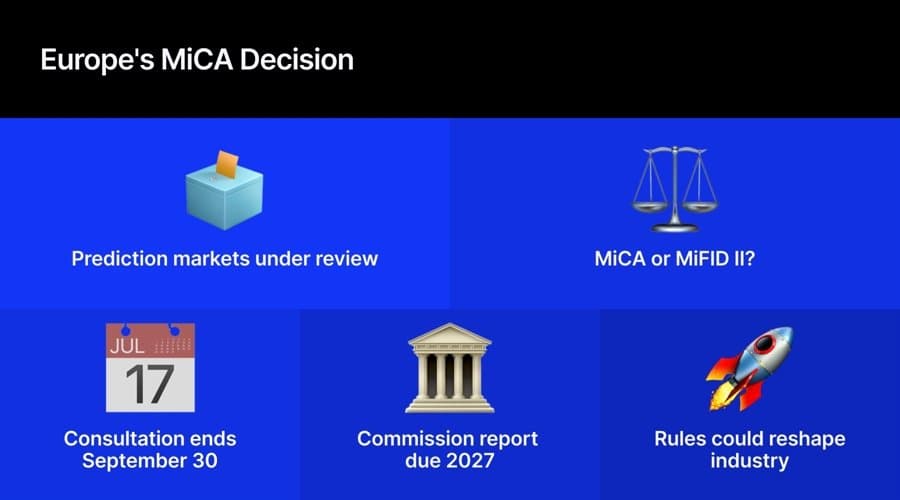
On May 20, 2026, the European Commission launched a focused consultation that could redefine how prediction markets based on distributed ledger technology (DLT) are regulated across the EU. The consultation is part of the broader review of the Markets in Crypto-Assets (MiCA) Regulation, marking the first formal inquiry into whether and how these emerging markets fit within the EU's regulatory framework.
The original deadline for feedback was August 31, but it has been quietly extended to September 30, 2026. According to the Commission's consultation page, this extra month is key, providing the industry a final chance to influence how rules will be shaped ahead of the Commission's report to the European Parliament and Council due by June 30, 2027. This report, mandated by MiCA Articles 140 and 142, may be accompanied by new legislative proposals that could impact crypto regulation for years.
key Regulatory Crossroads
The consultation document, prepared by DG FISMA's digital finance unit, highlights prediction markets along with DeFi, staking, NFTs, and perpetual futures as fast-growing areas currently not covered by MiCA. The key question posed is whether crypto-based prediction markets and perpetual contracts should fall under MiCA's crypto-specific regulations or the stricter MiFID II rules governing traditional financial instruments.
This distinction is significant. Under MiCA, a prediction market operator might become a licensed crypto-asset service provider capable of passporting across the European Economic Area. Conversely, MiFID II imposes heavy restrictions, including the EU's product intervention measures that previously banned binary options for retail clients, effectively making certain prediction market contracts difficult to operate legally.
Adding to the debate, the European Securities and Markets Authority (ESMA) clarified on July 3, 2026, that event contracts tied to assets listed in MiFID II's Annex I are considered financial instruments. As such, they are subject to national bans on marketing and selling binary options to retail investors, further complicating the regulatory landscape for prediction markets.