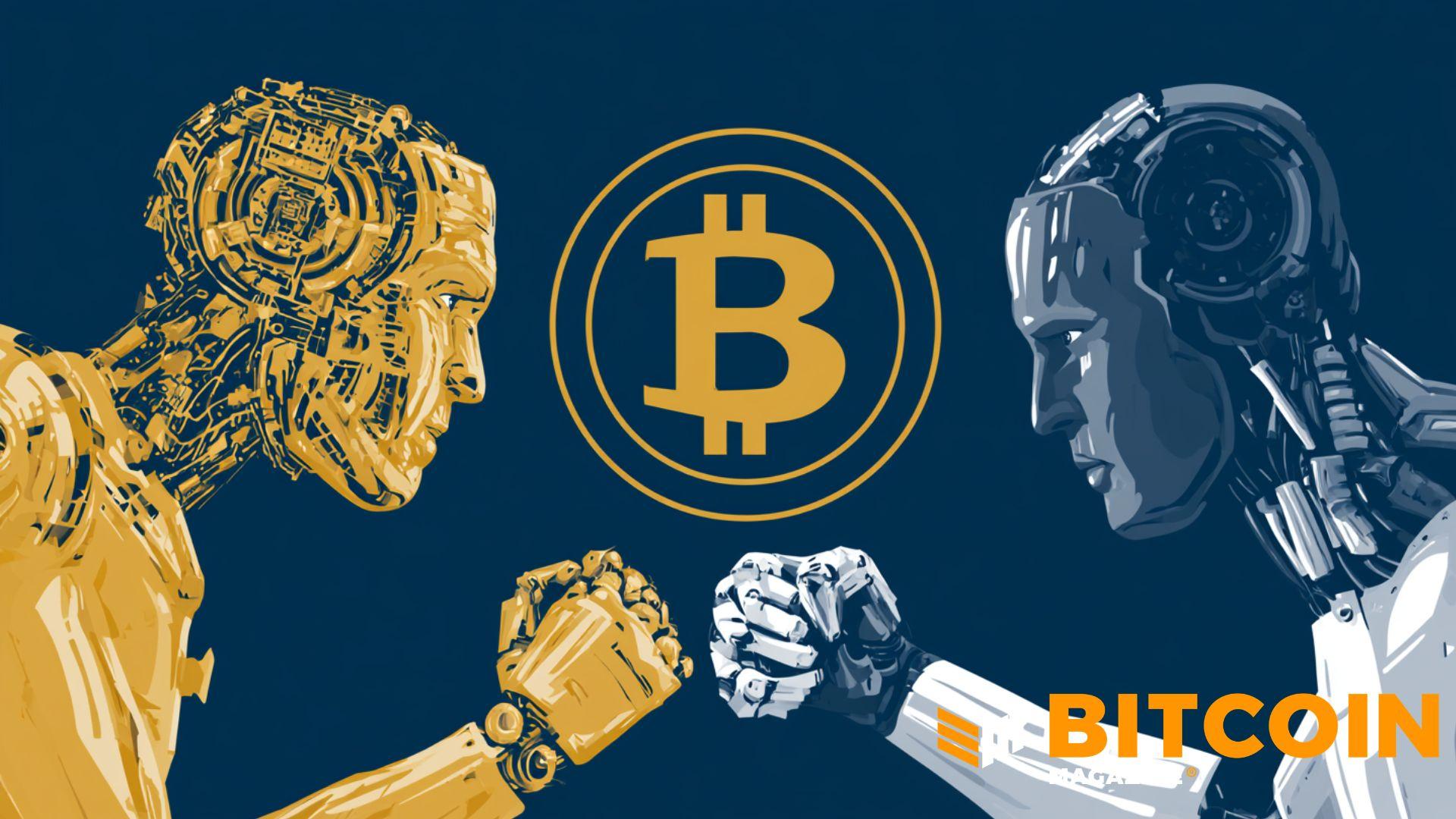
Decentralized AI and the Ghost of 2014: What the Open-Source Crackdown Really Means for Investors
Ben Lilly of Brownstone Research draws a detailed structural parallel between today's open-source AI crackdown and Bitcoin's early regulatory battles — and argues that decentralized AI projects may represent the most asymmetric investment opportunity since 2014. Here is what the pattern means for the market.
History rarely repeats itself exactly, but it rhymes with unsettling precision. The current regulatory pressure on open-source artificial intelligence is drawing a pattern that veteran crypto investors will find immediately recognizable — because they lived through its first iteration with Bitcoin. Ben Lilly of Brownstone Research, writing in his 'Chain of Thought' newsletter, makes this case with a level of analytical specificity that deserves serious consideration rather than dismissal.
The argument begins not with a conspiracy theory but with congressional testimony. In July 2023, Anthropic CEO Dario Amodei appeared before Congress and offered a carefully worded endorsement of open-source science — while simultaneously warning that scaling open AI models was heading 'down a very dangerous path.' Lilly's reading of the subtext is sharp: if open models are framed as dangerous, then closed, proprietary models become the safe, policy-endorsed alternative. The commercial beneficiary of that framing is obvious — companies like Anthropic itself. This is not merely cynicism; it is the standard playbook of incumbent advantage-seeking through regulatory capture.
The Bitcoin parallel is more than metaphorical. In 2014, Rep. Jared Polis made history by purchasing the first Bitcoin on Capitol Hill, while Sen. Joe Manchin was simultaneously calling for an outright ban on what he labeled a 'dangerous currency.' Fast forward to 2023, and critics alleged that regulators orchestrated 'Operation Choke Point 2.0,' a coordinated effort to sever crypto's access to the banking system. The industry absorbed those blows, adapted, and is now watching the GENIUS Act pass and the CLARITY Act move through the legislative pipeline — a testament to the resilience of decentralized networks when faced with institutional resistance.
Lilly argues that Decentralized AI — which he brands 'DeAI' — is now entering that same crucible. The evidence he cites is concrete. A U.S. export ban has been placed on Anthropic's latest model release, pushing the company toward permissioned access systems that require identity verification before a user can interact with the model. OpenAI has similarly restricted its GPT-5.6 rollout to a closed circle of trusted partners. The walls, Lilly contends, are already going up — and identity requirements are the enforcement mechanism of choice. His sardonic observation: 'It's for your protection, you see. It always is.'
The national-security dimension lends real weight to the regulatory anxiety. Lilly references NSA chief Joshua Rudd's account, surfaced via Sen. Mark Warner, in which Anthropic's 'Mythos' model reportedly penetrated 'almost all' classified U.S. systems — not in weeks, but in hours. That is a genuinely alarming data point, and it explains why policymakers are reaching for restriction rather than nuance. But Lilly's counter-argument is equally grounded in evidence: open-source models are closing the capability gap faster than regulators can respond. The recently released GLM-5.2 already benchmarks on par with Anthropic's Sonnet 4.6 from February 2026, leaving open models roughly three to four months behind the frontier — a gap that, at current development velocity, could close by autumn.
The deeper structural argument concerns infrastructure, not just models. Lilly draws a direct analogy between Bitcoin's proof-of-work mechanism — compute exchanged for network security — and the emerging architecture of decentralized AI training, where compute is exchanged for model-training participation. Distributed training has scaled from sub-1-billion parameters to 100 billion parameters within two years. That is not incremental progress; it is a trajectory that mirrors early blockchain scaling curves.
Three specific projects are named as early-stage plays in this space: Dark Bloom, which enables low-cost private inference on idle Mac hardware; c0mpute, a decentralized inference network; and Pluralis, which trains AI models across distributed consumer GPUs. Lilly anticipates that projects of this type will increasingly launch tokens and create reward mechanisms for compute contributors — replicating the miner-incentive model that bootstrapped Bitcoin's network effect.
The investment thesis, then, is not speculative hand-waving. It is a pattern-recognition argument grounded in the structural similarities between two disruptive technologies facing institutional resistance at comparable stages of development. If governments attempt to ban open AI models — as Lilly believes they will — the likely outcome mirrors what happened with crypto: partial restriction, underground resilience, and eventual legitimization. For investors willing to accept early-stage risk, the comparison to buying Bitcoin in 2014, 'back when it was still dangerous,' is not hyperbole. It is a calibrated historical analogy. The question is whether the market is paying attention early enough to matter.