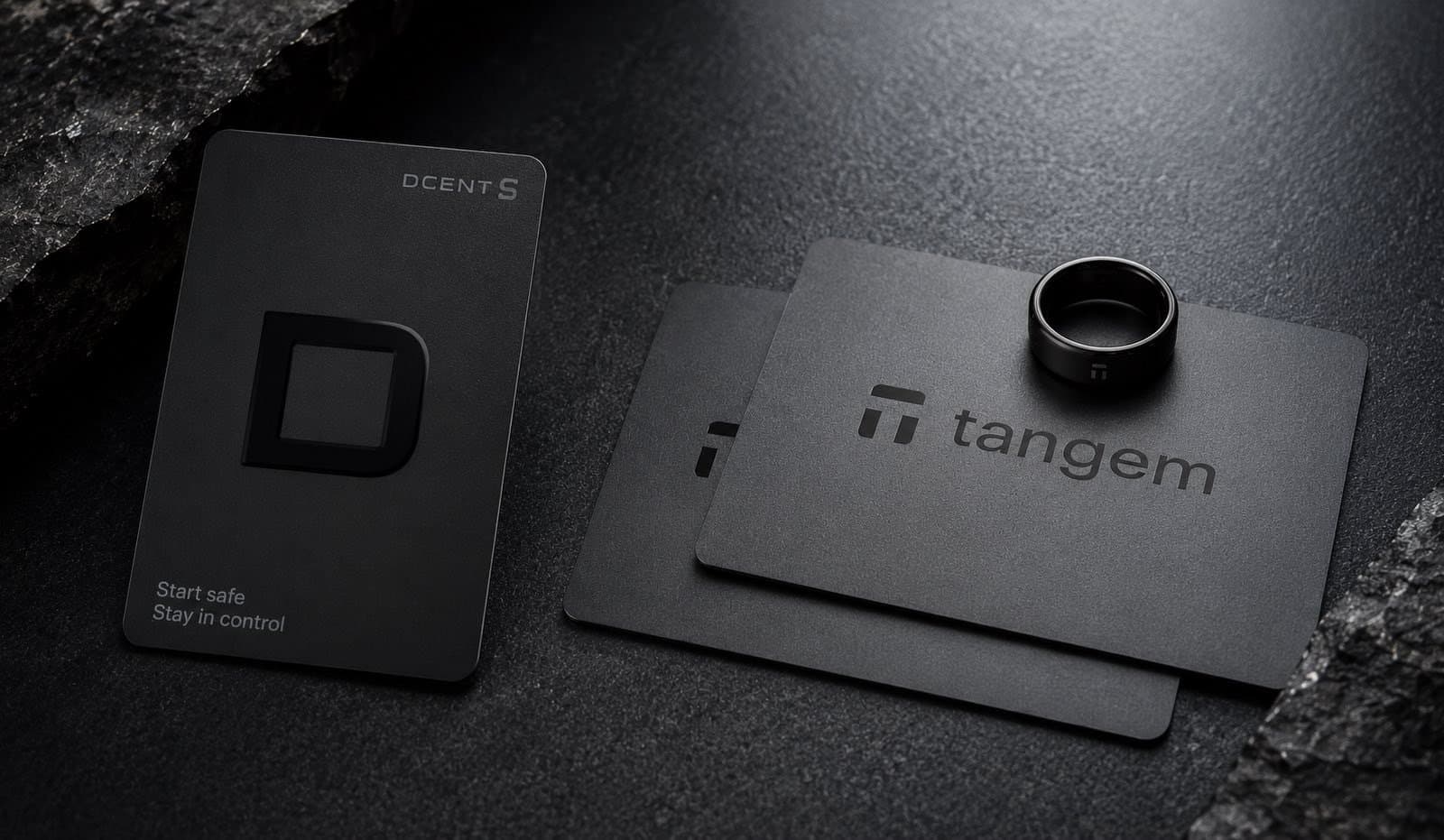
Pick up either of these devices and you might mistake it for a loyalty card. DCENT S and Tangem both pack a certified secure element into a credit-card-sized slab of plastic, skip cables entirely, and sign transactions over NFC with a tap. The similarities end there surprisingly quickly, though, and the gap that matters most is in how each wallet handles backup and recovery.
DCENT S launched in July 2026 out of South Korea, built by IOTRUST, a company with a long history in hardware wallet engineering. Tangem has been around longer and comes from Switzerland, where its team leaned hard into simplicity for first-time buyers. Both carry EAL6+ secure element certification, the same grade used in passports and high-end payment chips. Both are seedless, meaning no 24-word phrase to write down and hide under the mattress.
Where the two wallets actually split
The backup philosophy is the real dividing line. Tangem ships in sets of two or three identical cards, each capable of signing transactions independently. Lose one, use another. That works, but it also means every card in the set is equally powerful, equally dangerous if stolen. DCENT S takes a different path: its R3covery Card is a dedicated chip-based backup that can restore your wallet but cannot sign transactions on its own. It exists purely for emergencies. For anyone worried about a thief grabbing a backup card and walking away with full access, that distinction is not trivial.
On paper specs, DCENT S supports 100-plus blockchains and around 4,900 tokens. Tangem comes in at 90-plus blockchains but a much wider 14,000-plus tokens. XRP users will notice that DCENT S goes deeper on XRPL, covering Trust Lines, dApps, and in-wallet swaps, while Tangem offers standard XRP support without those extras.
Both cards measure roughly 85.6 by 54 millimeters. DCENT S sits at 0.9 mm thick, thinner than most payment cards. Tangem matches it on feel and weight. The one physical feature Tangem has that DCENT S does not is a wearable ring option, handy for people who would rather not carry another card at all. Both devices carry IP69 or IP69K dust and water resistance ratings, so dunking either one is not a concern in everyday use.
The warranty gap is striking. DCENT S covers one year. Tangem offers 25 years, which is less a realistic service promise and more a statement about how long the hardware is built to last without a battery or moving parts.
For daily use both wallets run through dedicated mobile apps, DCENT App and Tangem App respectively. NFC pairing is straightforward on either platform, and neither requires Bluetooth setup or charging. The DCENT app goes broader on DeFi integrations for users who want to interact with dApps directly from the wallet interface.
Choosing between them comes down to one question: do you want identical backup cards that can each act as your primary wallet, or a dedicated recovery card that can restore access but cannot be used to spend funds on its own? That single design choice ripples through everything else about how you will live with either device day to day.
This article is for informational purposes only and does not constitute financial or investment advice. Always do your own research before making any purchasing or investment decisions.