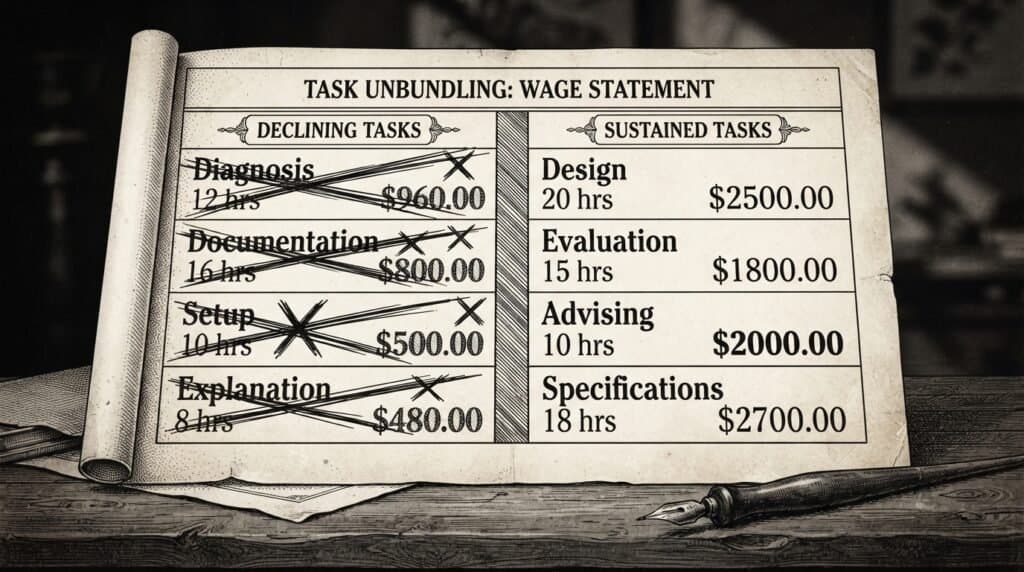
The economic worth of work is breaking down into its individual tasks as AI takes over specific job functions rather than entire roles. This insight comes from a fresh study by the ADP Research Institute and Stanford Digital Economy Lab, which analyzed payroll data from 26 million workers instead of relying on surveys or projections.
Using hedonic wage regression on data from 25,000 firms and 4.6 million workers, the researchers linked defined tasks in O*NET directly to payroll outcomes. Their findings show that tasks like system diagnosis, model development, documentation, and technical explanations activities AI can handle increasingly well are losing economic value. Employers are paying less for work that machines now perform competently.
On the other hand, tasks involving judgment, design, evaluation, advising on technology use, and directing technical projects are holding or even gaining value. These complex, strategic areas are still beyond AI's reliable reach. For companies, this means investments should favor roles with higher-order skills rather than execution-focused jobs that AI is commoditizing.
Impact on Early-Career Workers
The shift hits early-career employees hardest. The ongoing Canaries Dashboard collaboration reveals that workers aged 22 to 25 in jobs heavily exposed to AI face an annual employment decline of about 3.8%. Entry-level roles like software development and customer service are especially affected as the foundational tasks are automated away, shrinking the traditional training ground.
This task-level unbundling also shapes how organizations deploy AI. Despite only 31% of AI projects being fully rolled out according to Gartner, companies are already reorganizing teams at a rapid pace without waiting for perfect AI solutions.
This content is for informational purposes and does not constitute financial advice.